


Reading the Rainbow of Alien Atmospheres
To understand a planet hundreds of light-years away, scientists don't look at it directly; they study its light. Using a technique called transmission spectroscopy, powerful instruments like the James Webb Space Telescope (JWST) analyse starlight as it filters
through a planet's atmosphere during a transit. Different molecules absorb specific colours, or wavelengths, of light, leaving a unique barcode-like signature. Finding the tell-tale signature of water vapour is a monumental discovery, but it is often just the beginning. The presence of water, along with other molecules like methane and carbon monoxide, helps scientists build a profile of the planet's atmospheric chemistry.
Clouds Made of Sand and Salt
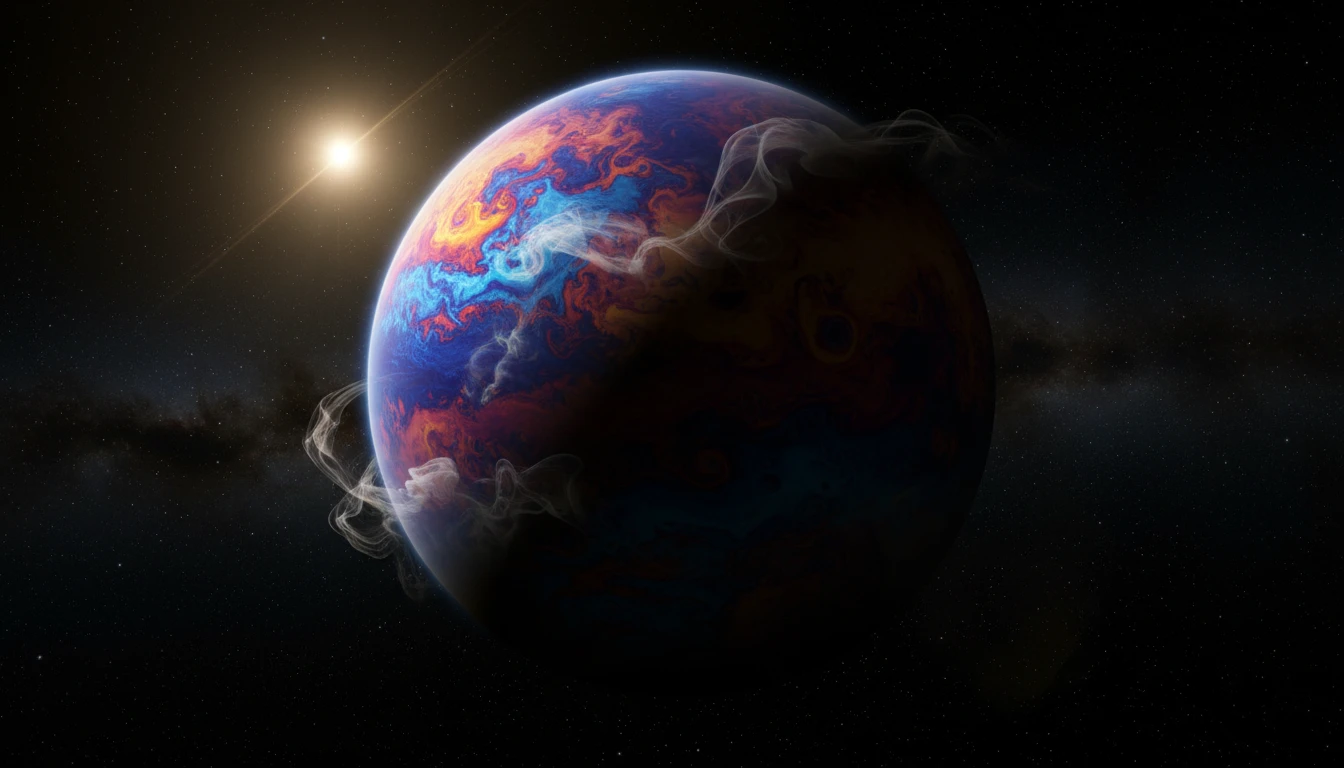
The phrase "complex clouds" on gas giants rarely refers to the fluffy, white water-ice clouds we see on Earth. On searingly hot exoplanets, where temperatures can reach 1000 degrees Celsius, other materials condense. Recent JWST observations of the exoplanet WASP-107b, for instance, revealed not just water vapour but also sulfur dioxide and clouds made of silicate particles—essentially, sand. On another world, VHS 1256 b, Webb detected swirling clouds of both fine, smoke-like silicate dust and larger, sand-like grains. Astronomers have even found evidence for salt clouds on a distant, cold planetary-mass object. The presence and altitude of these mineral clouds are inferred from how they block or absorb certain wavelengths of infrared light. Water vapour plays a crucial role here, as its signature can be muted or altered by these high-altitude clouds, giving away their presence.
A Barometer for Alien Weather
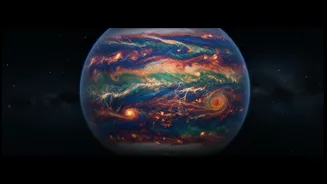
Water vapour isn’t just an ingredient; it's a tracer for atmospheric dynamics. The distribution and temperature of water molecules can reveal powerful weather patterns. On a gas giant, the atmosphere is a churning, violent place, with material constantly being dragged up from hotter depths and sinking back down. On a planet like WASP-107b, for silicate clouds to exist high in the atmosphere, there must be a vigorous cycle of condensation and upward transport, preventing the 'sand' particles from simply raining down into the planet's interior. By mapping where water vapour and other chemicals appear, scientists can essentially create a weather forecast for a world light-years away, identifying cycles of cloud formation and dissipation.
The Technology Behind the Discovery
These insights are a direct result of incredible technological investment and innovation. The James Webb Space Telescope, a multi-billion dollar international project, was specifically designed with instruments like the Mid-Infrared Instrument (MIRI) and Near-Infrared Spectrograph (NIRSpec) to perform this kind of revolutionary science. Its ability to capture high-resolution spectra across a wide range of infrared light allows it to identify a larger number of molecules at once than ever before and to detect the subtle signatures of exotic clouds. Before Webb, even with the world's biggest telescopes, many of these faint worlds were impossible to analyse in such detail. This technology transforms a faint dot of light into a world with discernible chemistry and weather.
Why We Study These Hostile Worlds
Gas giants like WASP-107b are not habitable. So why invest so much time in studying their sandy clouds and turbulent skies? Because understanding how atmospheres work in a vast range of conditions is fundamental to the search for life elsewhere. These extreme planets are natural laboratories that test and refine scientific models of planetary formation and climate. By figuring out the rules of atmospheric physics on a world with silicate clouds and 1,500-degree temperatures, scientists are better equipped to one day analyse the much fainter atmospheric signals from smaller, cooler, rocky planets and correctly interpret what they see.