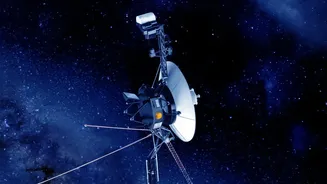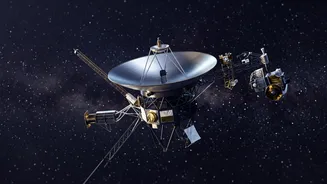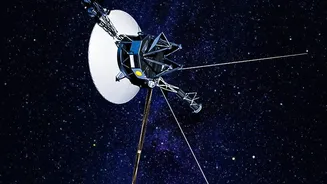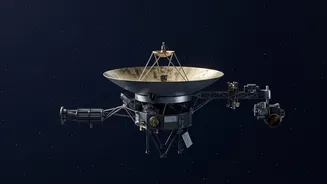




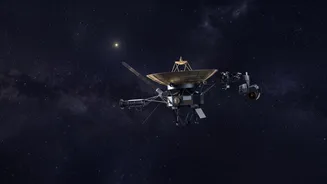
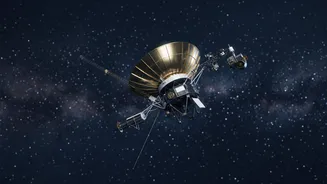
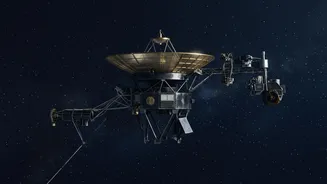
Far beyond the orbits of all the planets, a lone probe continues its silent journey into the cosmos. Launched nearly 50 years ago, NASA's Voyager 1 is about to cross a boundary that marks a new chapter in human exploration.
The Light-Day Milestone
On November 18, 2026, Voyager
1 will become the first object made by human hands to be one light-day away from our planet. A light-day isn't a measure of time, but of distance: it's how far a particle of light travels in 24 hours. That equates to a staggering 25.9 billion kilometres. To put that into perspective, light from the Sun takes a little over eight minutes to reach Earth. The signal from Voyager 1 will now take a full day to reach us, meaning a simple command and its confirmation will have a round-trip time of 48 hours. This achievement highlights not just the vastness of space, but the incredible endurance of a machine designed in the 1970s.
A Grand Tour and Beyond
Voyager 1, along with its twin Voyager 2, launched in 1977 on a mission to study the outer planets. Taking advantage of a rare planetary alignment, it flew by Jupiter in 1979 and Saturn in 1980, revolutionising our understanding of these gas giants. It discovered Jupiter's faint rings, the first active volcanoes beyond Earth on the moon Io, and the complex nature of Saturn’s majestic rings. After its flyby of Saturn's moon Titan, its primary mission was complete, and its trajectory flung it upwards, out of the plane of the planets, on a new path towards the stars.
Entering Interstellar Space
The probe made history again in August 2012 when it crossed the heliopause, the boundary where the Sun's constant stream of particles, known as the solar wind, is no longer strong enough to push back against the 'wind' from other stars. By leaving this protective bubble, Voyager 1 officially entered interstellar space, the medium between the stars. It is currently humanity's only operational probe directly sampling this uncharted territory, sending back invaluable data about an environment we have never been able to measure before. Even now, it is still detecting vibrations in the ionised gas of the interstellar medium.
An Old Probe With New Tricks
Keeping a nearly 50 year old spacecraft running billions of kilometres away is a monumental challenge. Its plutonium power source dwindles each year, forcing engineers at NASA's Jet Propulsion Laboratory to make difficult decisions about which instruments to shut down. The probe has also faced recent technical issues, including a frightening 48 hour communication blackout in October 2026 that it managed to resolve on its own by switching to a backup set of thrusters. This resilience is a testament to the brilliant engineering of its creators and the ingenious problem solving of the modern mission team who communicate with it across an ever widening gulf of space.
A Message in a Bottle
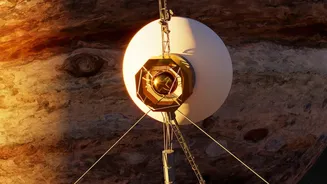
Aboard Voyager 1 is a special passenger: the Golden Record. This is a 12 inch, gold plated copper disk containing sounds and images selected to portray the diversity of life and culture on Earth. Curated by a committee chaired by the famed astronomer Carl Sagan, it includes greetings in 55 languages, music from different eras and cultures, and natural sounds from our planet. It is a message in a bottle cast into the cosmic ocean, a greeting for any civilization that might one day encounter the silent probe. Years before it left our solar system, Sagan convinced NASA to turn Voyager’s camera around one last time to take the famous 'Pale Blue Dot' photograph, showing Earth as a tiny speck suspended in a sunbeam from 6.4 billion kilometres away.