



From Cages to Colleagues
For decades, industrial robots were powerful but dangerous, kept separate from human workers by physical cages. The new frontier is 'collaborative robots', or 'cobots', designed to share a workspace with people. This shift, central to the concept of Industry
5.0, aims to combine the precision and endurance of machines with the creativity and problem-solving skills of humans. However, making this partnership truly safe is complex. It requires more than just stopping when a person gets too close; it requires the robot to understand and anticipate human actions, moving from a simple tool to a genuine collaborator. The challenge lies in creating robots that are not only aware of their surroundings but can also interact with them safely and intelligently.
Eka's 'Physical Intelligence' Approach
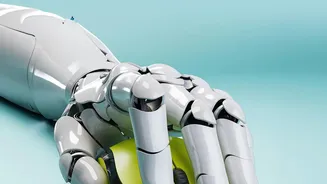
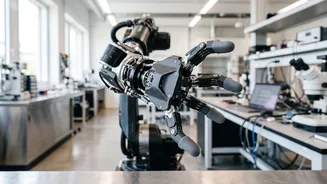
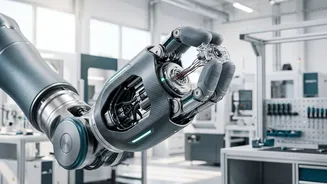
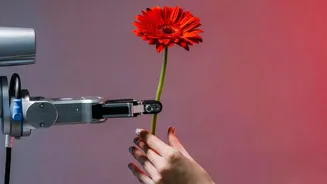
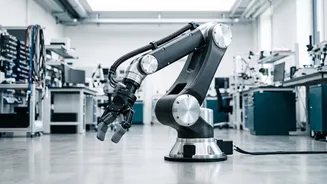
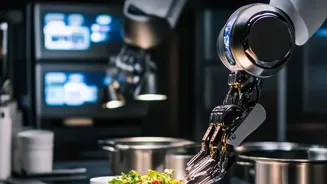
Eka Robotics, a startup founded by experts from MIT and Google DeepMind, is addressing this challenge with a novel AI model they call Vision-Force-Action (VFA). Unlike many robotic systems that rely primarily on vision (cameras) and pre-programmed instructions, Eka's model adds a crucial third element: force. Their custom-designed robotic hands are equipped with advanced sensors that provide a sense of touch, allowing the robot to 'feel' an object. This physical feedback is key. It enables the robot to detect if a grip is slipping and adjust it, or to sense resistance when inserting a part and change its motion, rather than just stopping or causing an error. Eka calls this 'physical intelligence', where the robot learns from and reacts to the physical world directly.
AI and Simulation: The Core of Safety
The intelligence behind Eka's robots is honed not just in the real world, but in hyper-realistic simulations. The company uses reinforcement learning, a type of AI where the model learns through trial and error, to run millions of practice scenarios in a virtual environment. This allows the robots to experience and learn from countless situations, including rare or hazardous ones, in a fraction of the time it would take with physical trials. By simulating the principles of physics like mass and inertia, the AI develops an 'intuition' for how objects will behave. This proactive approach, where safety is learned and predicted rather than simply reacted to, marks a significant evolution from older safety systems that relied on fixed rules and boundaries.
Beyond Safety: Superhuman Performance
While safety is a cornerstone, Eka's project is also about boosting performance. The company reports its robots can perform tasks like picking and placing objects at a rate of 1,500 per hour, more than double the average human rate of around 600. They achieve this with a success rate of over 95% across a wide variety of objects, even ones they haven't been specifically trained on. This combination of speed, reliability, and adaptability is what makes the technology so promising for industries. The same underlying model that can gently handle a strawberry can also be used for complex assembly tasks like screwing in a lightbulb or inserting delicate wires, demonstrating a level of dexterity that has long been a challenge for automation. This ability to generalize across different tasks without extensive retraining is a key differentiator.
The Future of Work in India
The implications for Indian industries such as manufacturing, logistics, and even healthcare are profound. As India continues to grow as a global manufacturing hub, the need for efficient and safe automation is paramount. Eka's technology, officially launched in October 2026, could help factories improve productivity while enhancing worker safety. By delegating strenuous and repetitive tasks to robots, human workers can be upskilled and redeployed to roles that require critical thinking, creativity, and oversight. This model of human-robot teaming can alleviate labour shortages in certain sectors and improve ergonomic conditions on the factory floor. While the technology still needs to prove its reliability in long-term, real-world industrial settings, it points towards a future where human-robot teams drive the next wave of industrial innovation.