


A Planet of Extremes
Venus is often called Earth's twin due to its similar size and mass, but the similarities end there. It’s a hellish world with surface temperatures hot enough to melt lead, crushing atmospheric pressure 90 times that of Earth's, and clouds of sulfuric
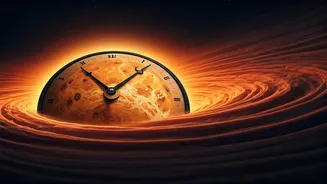
acid. But perhaps its most mind-bending feature is its calendar. To put it simply, Venus takes about 225 Earth days to complete one orbit around the Sun, which defines its year. However, it takes a staggering 243 Earth days to rotate just once on its axis. This means that a single rotational day on Venus is 18 Earth days longer than its entire year. It’s a planetary paradox that has puzzled scientists for decades, stemming from a unique combination of cosmic history and atmospheric physics.
Defining the Day: A Crucial Distinction
When we talk about a 'day,' it's important to know which kind we mean. A 'sidereal day' is the time it takes for a planet to complete one full 360-degree rotation on its axis. As we've seen, for Venus this is 243 Earth days. However, what most of us think of as a day—the time from one sunrise to the next—is called a 'solar day.' Because Venus spins backwards (a phenomenon known as retrograde rotation), its solar day is significantly different. The combination of its slow, backward spin and its orbit around the Sun results in a solar day that is 'only' about 117 Earth days long. So, while you'd be waiting longer than a year for the planet to complete one spin, you would see about two sunrises in that same period. Still incredibly long, and still bizarre.
The Slow, Backward Spin
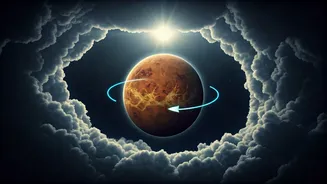
The primary reason for Venus's long day is its exceptionally slow, retrograde rotation. While most planets in our solar system, including Earth, spin counter-clockwise, Venus spins clockwise. Why? The leading theory suggests this wasn't always the case. Early in its history, a massive collision with a planet-sized object could have knocked Venus off-kilter, reversing its spin and dramatically slowing it down. Another theory points to the Sun's immense gravitational pull. Over billions of years, a gravitational tug-of-war between the Sun and Venus’s incredibly thick atmosphere may have created a 'tidal lock,' slowing the planet's rotation to its current crawl. The spin is so leisurely that you could easily out-walk the speed of rotation at the equator.
An Atmosphere That Acts Like a Brake
Venus’s atmosphere isn't just a bystander in this story; it's an active participant. The planet is shrouded in a blanket of carbon dioxide so dense that it behaves almost like a fluid. This atmosphere is in a state of 'super-rotation,' whipping around the planet once every four Earth days—over 60 times faster than the planet itself rotates. Scientists believe this creates an enormous amount of friction and drag on the planetary surface. This atmospheric tide, pulling against the solid planet, acts like a powerful brake, contributing to the deceleration of Venus's spin over geological timescales. Essentially, the very air on Venus is helping to make its days agonisingly long.