

The Sun's Final Act
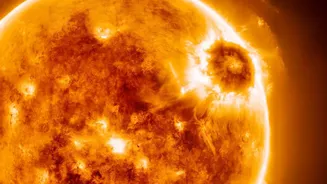
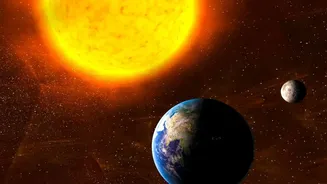
Our Sun, currently a stable star about 4.6 billion years old, will not burn forever. In about another five billion years, it will exhaust the hydrogen fuel in its core. This will trigger a dramatic transformation. The Sun will swell into a red giant,
expanding to a size that will engulf the inner planets, including Mercury, Venus, and possibly Earth. After this phase, which will last about a billion years, the Sun will shed its outer layers, leaving behind a dense, hot stellar core called a white dwarf. This tiny remnant, roughly the size of Earth, will contain about half the Sun's original mass. It's this profound loss of mass that sets the stage for chaos in the outer solar system.
A Weaker Grip on the Planets
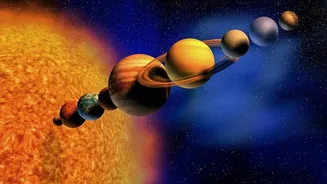
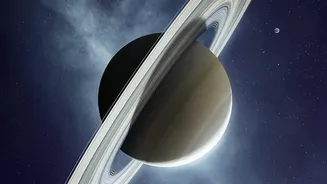
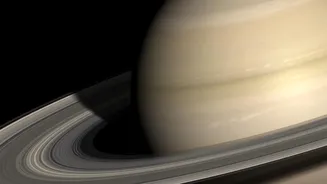
The planets stay in their orbits because of the Sun's immense gravitational pull. As the Sun sheds nearly half its mass, its gravitational grip will weaken significantly. For a long time, scientists believed this mass loss would be a smooth, gradual process. In that scenario, the surviving outer planets—Jupiter, Saturn, Uranus, and Neptune—would simply drift into wider, stable orbits roughly twice their current size. They would then continue to circle the white dwarf for an almost unimaginably long time, perhaps hundreds of billions or even a quintillion years, until a passing star eventually disrupted them.
Cosmic Kicks and Chaotic Orbits
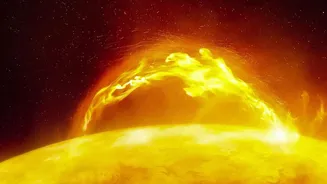
However, a recent study published in The Astrophysical Journal Letters presents a far more turbulent picture. Researchers at the California Institute of Technology argue that the Sun won't lose mass smoothly. Instead, it will happen through uneven, violent bursts of material, a process that delivers 'stochastic kicks' to the planets. These repeated, random gravitational nudges will slowly push the planets' orbits out of their stable alignment. The once-orderly system will start to behave like a random walk, with planetary paths becoming more stretched and tilted over time.
Uranus and Neptune's Great Escape
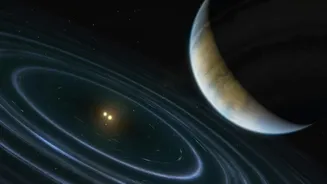
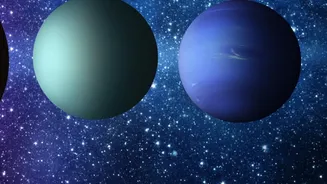
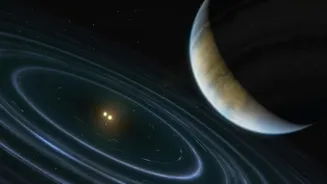
The new simulations show that this chaotic dance has dramatic consequences for the ice giants, Uranus and Neptune. With their orbits destabilized, all manner of strange scenarios become possible. In some simulations, the two planets swap places. In others, their orbits become so elongated that they cross paths with the other giants, leading to a chain reaction of gravitational disturbances. This instability can eventually lead to one or more planets being ejected from the solar system entirely, sent flying into interstellar space as rogue worlds. While Jupiter and Saturn are also affected, the outermost planets are particularly vulnerable to this grand-scale disruption.
A New, Shorter Timeline
This new understanding dramatically shortens the lifespan of our solar system's structure. Instead of surviving for quintillions of years, the study suggests that instability will take hold much sooner. The computer models show that in about 40% of cases, the planetary system shows signs of violent disruption even before the Sun has fully become a white dwarf. Within about one to three billion years after the white dwarf forms, a staggering 90-96% of the simulations result in a chaotic, unstable system. While this is still an immense amount of time, it revises our understanding of cosmic endings, suggesting they can be triggered not just by outside forces, but from the death throes of the parent star itself.