



What is the 'Tower-Catch' Strategy?
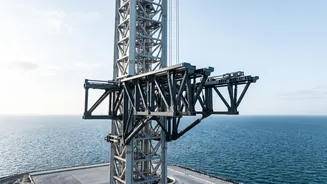
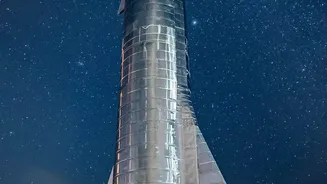
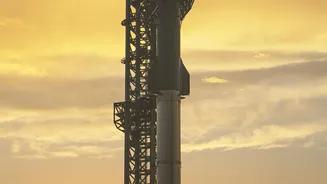
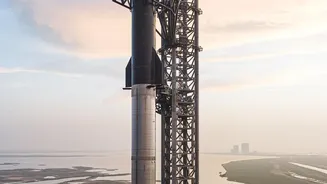
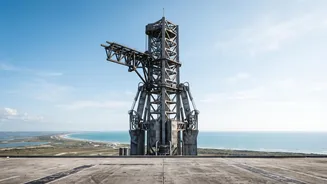
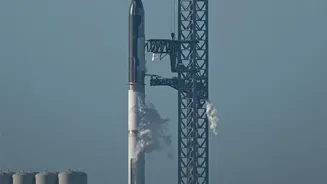
SpaceX is developing a system, nicknamed 'Mechazilla' by CEO Elon Musk, to catch its returning Super Heavy booster using the launch tower itself. The nearly 150-meter-tall structure is outfitted with two massive, movable arms, often called 'chopsticks',
that are designed to close around the booster as it hovers for landing. The arms grab onto the booster’s grid fins—the four waffle-patterned surfaces near the top that help steer it during descent. This maneuver eliminates the need for landing legs entirely, a radical departure from how SpaceX currently recovers its Falcon 9 rockets.
From Landing Legs to Chopsticks
SpaceX has already mastered rocket recovery, routinely landing its Falcon 9 boosters on drone ships or concrete pads. So why the change for Starship? The answer comes down to mass and speed. Landing legs for a vehicle as massive as the Super Heavy booster would be incredibly heavy, and every kilogram dedicated to landing gear is a kilogram that can't be used for payload. By removing the legs, SpaceX can increase the rocket’s lift capacity. Furthermore, catching the booster directly at the launch mount is the key to rapid reusability. In theory, a caught booster can be inspected, stacked with a new Starship upper stage, refueled, and launched again in under an hour. This transforms the turnaround from weeks or days into something more like an airline's ground operations.
A High-Stakes Engineering Feat
The tower-catch maneuver is one of the most complex engineering challenges in modern rocketry. The Super Heavy booster, weighing hundreds of tons even when nearly empty of fuel, must execute a series of precise engine burns to fly back to the launch site and slow itself to a near-hover beside the tower. The guidance systems must be accurate within a meter or two for the arms to safely secure the vehicle. The hydraulic systems and structural integrity of the tower arms themselves are also critical, as they must absorb the immense kinetic energy of the descending booster without fail. A successful catch was first achieved in October 2024, proving the concept was viable. However, subsequent test flights have shown the system's sensitivity, with one catch attempt being aborted due to potential damage to tower hardware during launch.
Why Take Such a Massive Risk?
For SpaceX, the reward is worth the risk because the tower-catch strategy is fundamental to the entire economic model of Starship. Musk’s goal is to dramatically reduce the cost of access to space, by a factor of 100 or more, making interplanetary travel economically feasible. This is only possible through full and rapid reusability of both the booster and the Starship upper stage. Achieving an airline-like launch cadence, with multiple flights per day, would enable the deployment of the massive Starlink satellite constellation and support NASA's ambitious plans for returning to the Moon under the Artemis program, which relies on Starship for tanker flights and as a lunar lander.
The Next Frontier: Catching the Ship
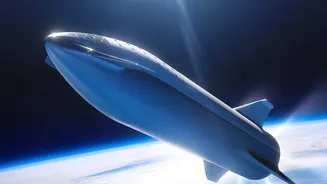
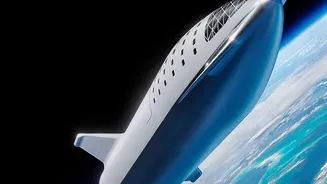
While SpaceX has successfully caught the Super Heavy booster, the next major milestone is to catch the Starship upper stage in the same manner. This is an even greater challenge, as the ship returns from orbital velocity and must endure the intense heat of reentry before performing a similar flip-and-land maneuver at the tower. Recent test flights have focused on bringing the ship back for a soft splashdown in the ocean to gather data on its reentry performance. The company is now planning to attempt the first catch of the Starship upper stage in an upcoming flight, which would mark the first time an orbital-class rocket has been fully recovered for reuse.