




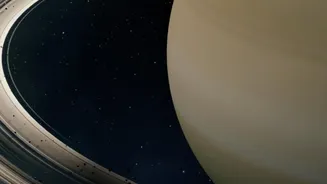
A New Eye on an Old Wonder
For over 400 years, since Galileo first glimpsed them as strange 'handles', Saturn's rings have been a source of scientific fascination. Composed of countless particles of ice and rock, they form a vast, shimmering disk that makes Saturn the jewel of our solar
system. Yet fundamental questions have remained: How old are they? How did they form? And how long will they last? Previous missions, like the heroic Cassini probe, gave us unprecedented close-ups but also deepened the puzzle. Now, the James Webb Space Telescope is using its powerful infrared vision to peel back new layers of the mystery. Its ability to see in wavelengths invisible to the human eye allows it to detect heat and chemical signatures that other telescopes, even the Hubble, cannot. This provides a completely different view, one that is already reshaping our understanding.
The Great Debate: Young or Old?
One of the biggest debates revolves around the rings' age. For a long time, many scientists believed the rings were young, perhaps only a few hundred million years old—meaning they would have formed long after the dinosaurs roamed the Earth. This theory was based on their pristine, icy composition; it was thought that over billions of years, the rings should have been darkened and 'polluted' by a constant rain of micrometeoroids. However, some recent studies leveraging data from missions like Cassini suggest the rings might be much older, potentially dating back to the formation of the solar system itself, around 4.5 billion years ago. One theory proposes a 'self-cleaning' mechanism where meteoroid impacts vaporize and eject material, keeping the rings sparkling clean despite their age. JWST's observations are helping to test these competing ideas, offering new data on the rings' composition and dynamics.
Ring Rain and a Fleeting Existence
Perhaps the most dramatic revelation is that Saturn's rings are not a permanent feature. Scientists have known since the 1980s that the rings are actively disappearing, with material raining down onto the planet's atmosphere. This 'ring rain' is a staggering phenomenon, with estimates suggesting that an amount of water equivalent to an Olympic-sized swimming pool falls onto Saturn every day. Data from the Cassini spacecraft showed that between 400 and 2,800 kilograms of icy material pour into the planet's atmosphere every second. At this rate, the rings are facing a relatively quick death in cosmic terms. While estimates vary wildly, some suggest they could be gone in as little as 100 million years, while other models give them up to 1.1 billion years. JWST is now part of a long-term campaign, alongside the Keck Observatory, to monitor this process over a full Saturnian season (about seven Earth years) to get a more precise forecast for their demise.
A Glimpse of the Future
JWST’s observations are not just about the past and future demise of the rings, but also their current, dynamic state. The telescope has provided incredible infrared images where the planet itself appears dark—due to methane in its atmosphere absorbing sunlight—while the icy rings glow brightly. This unique view helps highlight structures and even some of Saturn's many moons. Furthermore, Webb's data helps scientists understand how the rings interact with the planet. For example, some of the 'ring rain' is thought to be influenced by the planet's magnetic field and its exposure to solar radiation, a process that JWST can help analyze in detail. Understanding how these magnificent but temporary structures form, evolve, and die provides a crucial laboratory for studying the processes that shaped our entire solar system.