





A Tale of Two Galaxies
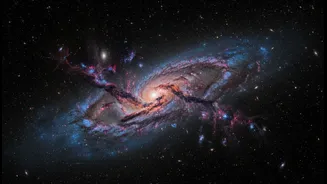
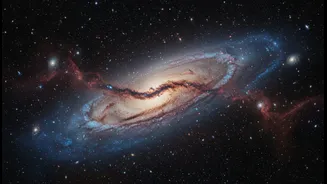
Located about 11 million light-years from Earth, Centaurus A is not your average galaxy. In visible light, it looks like a giant elliptical galaxy that has been violently interrupted by a thick, dark lane of cosmic dust. For decades, astronomers have
recognised this peculiar shape as the aftermath of a colossal cosmic collision. Models suggest that roughly two billion years ago, a large elliptical galaxy devoured a smaller, gas-rich spiral galaxy. The wreckage of that galactic merger is the chaotic dust band we see today, a structure so prominent that it hides the galaxy's very heart from our view. This violent history makes Centaurus A an object of intense study, a nearby laboratory for understanding the forces that shape galaxies across the universe.
The Power of Invisible Light
The problem with cosmic dust is that it acts like a thick fog, blocking the shorter wavelengths of light, including the visible light our eyes can see. This is where infrared astronomy changes the game. Infrared light has a longer wavelength that can pass through these dense clouds of gas and dust largely unhindered. Think of it like the difference between a flashlight and an X-ray; where one is stopped by a solid object, the other passes right through. By building telescopes that can detect this invisible infrared light, astronomers gain a superpower: the ability to peer into regions of space that would otherwise be completely obscured. Suddenly, the dark, impenetrable dust lanes in galaxies like Centaurus A become transparent, revealing the secrets they hold within.
What the Dust Was Hiding
Thanks to the powerful infrared vision of the James Webb Space Telescope (JWST), we now have an unprecedented view of what lies behind Centaurus A’s dusty veil. Recent images, released in July 2026 to celebrate the telescope's fourth year of operations, cut through the darkness to reveal a stunningly complex scene. Instead of a void, astronomers found a teeming core packed with millions of individual stars, their light finally able to reach us. These observations uncovered intricate filaments of glowing dust and a warped, rotating disc of warm gas being fed to the galaxy's central supermassive black hole. The clarity is so great that scientists can now distinguish between different generations of stars, effectively performing galactic archaeology to piece together the galaxy's violent history star by star.
A Cosmic Engine Revealed
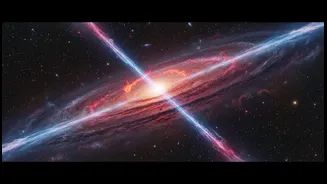
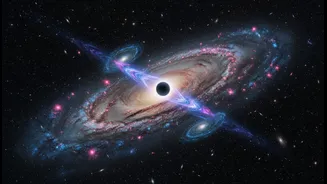
The infrared view doesn't just show hidden stars; it reveals the mechanics of the galaxy’s powerful central engine. At the heart of Centaurus A is a supermassive black hole about 55 million times the mass of our sun. This black hole is actively feeding on the gas and dust from the galactic merger, launching colossal jets of energy that stretch for thousands of light-years. Infrared observations by JWST allow astronomers to see the complex interplay between this black hole and its host galaxy. They can now measure how the black hole’s energetic output both triggers new star formation by compressing gas and limits it by blowing material away. Centaurus A provides one of the clearest, closest examples of this fundamental cosmic relationship.
A Key to the Universe
The lessons from Centaurus A underscore why infrared astronomy is so vital. This technique is not just for looking through dust in nearby galaxies. It is essential for studying the birth of stars, which happens inside dense, dusty stellar nurseries that are opaque to visible light. It allows us to analyse cooler objects like planets and asteroids that don't shine brightly on their own. Perhaps most importantly, infrared vision is how we look back in time. As the universe expands, the light from the most distant and earliest galaxies gets stretched to longer, redder wavelengths. To see the dawn of cosmic history and the formation of the very first galaxies, we must look for their faint infrared glow. Centaurus A, in all its chaotic glory, is a spectacular reminder that much of the universe's story is written in a light we cannot see.