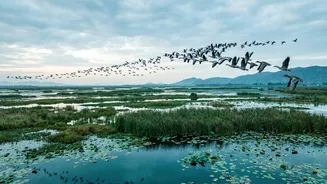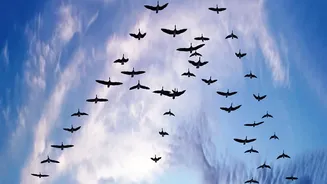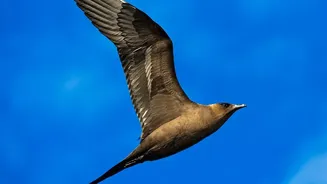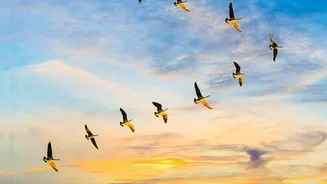




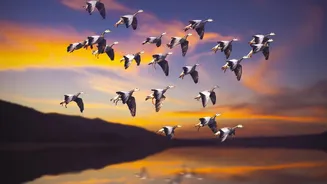

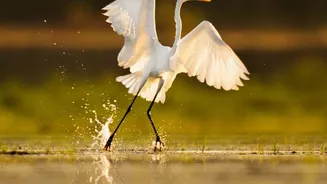
As autumn chills the air across Central Asia and Siberia, an ancient rhythm stirs. For millions of birds, this seasonal shift is a powerful, instinctual cue to embark on one of nature's most spectacular and perilous journeys southward to India.
The Inevitable Northern Signal
The primary
catalyst for this mass movement is not the first snowfall, but a more subtle, yet powerful, combination of environmental cues. The most significant trigger is the change in day length, or photoperiod. As days grow shorter in their northern breeding grounds, it signals a change in the pituitary gland of birds, initiating hormonal shifts that prepare them for the arduous journey ahead. This internal biological clock is reinforced by dropping temperatures and a dwindling food supply, as insects die off and plants become dormant. This combination of factors essentially serves as an eviction notice, compelling species from waterfowl to tiny warblers to seek the warmer climes and abundant food resources of the Indian subcontinent for the winter.
The Ultimate High-Altitude Test
The journey to India is not a simple flight; it involves conquering the most formidable natural barrier on Earth: the Himalayan mountain range. Birds like the iconic Bar-headed Goose are famous for this incredible feat, flying at altitudes where oxygen levels are only a third to a half of what they are at sea level. It’s a region where humans would struggle to survive, let alone perform the metabolically demanding act of flight. To achieve this, these birds employ a 'roller-coaster' flight pattern, following the terrain to conserve energy, and often fly at night or in the early morning when the air is colder, denser, and calmer. While some reports have cited them flying over Mount Everest, tracking studies confirm they typically use high passes, reaching staggering altitudes of up to 7,290 meters (nearly 24,000 feet) under their own power.
Built for the Gruelling Journey
Survival at such extreme altitudes requires a suite of remarkable physiological adaptations. The Bar-headed Goose, a marvel of evolution, possesses larger lungs and a more efficient breathing pattern than other birds. Their blood is also uniquely suited for the task; a special type of hemoglobin binds to oxygen more readily, ensuring their muscles receive enough fuel even in the thin mountain air. Furthermore, they have a greater density of capillaries around their pectoral muscles to improve oxygen delivery. Before the journey even begins, these birds undergo significant changes, accumulating large fat reserves that will fuel their non-stop flight across thousands of kilometres. This stored fat also provides essential water through metabolic processes.
Navigating Nature's Superhighway
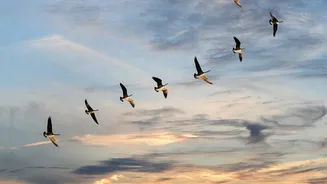
This epic migration follows a well established aerial route known as the Central Asian Flyway (CAF), a vast corridor connecting the northern breeding grounds in the Arctic and Siberia with wintering areas in South Asia. This flyway, which spans 30 countries, is a superhighway for over 180 species of migratory waterbirds. Scientists believe birds use a sophisticated combination of navigational tools, including the Earth's magnetic field, the position of the sun and stars, and topographical landmarks like mountain ranges and coastlines, to stay on course. India plays a critical role in the CAF, with the government formally backing an initiative to protect the flyway, which provides essential stopover and wintering habitats for these long distance travellers.
A Welcome Arrival in India
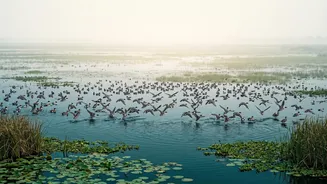
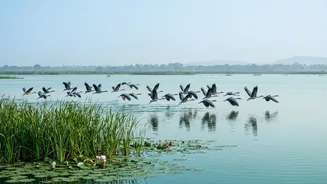
After their exhausting journey, the birds arrive in India from October onwards, transforming the country's wetlands into bustling, noisy spectacles. These sites offer a much needed respite with warmer temperatures and plentiful food. Key destinations across the country become birding hotspots. Keoladeo National Park in Rajasthan, a UNESCO World Heritage Site, hosts over 370 species, including Bar headed Geese and Demoiselle Cranes. Chilika Lake in Odisha, India's largest coastal lagoon, becomes a haven for vast flocks of flamingos and other waterfowl. Other vital wintering grounds include Nal Sarovar in Gujarat, Pong Dam in Himachal Pradesh, and numerous wetlands across the subcontinent, all providing critical sanctuary until the birds begin their return journey north in the spring.