
An Invisible Rain from Space
First, let's clarify what we mean by 'cosmic rays'. The name is a bit of a historical misnomer, as they aren't rays of light at all. They are fragments of atoms—mostly protons and atomic nuclei—that have been stripped of their electrons and accelerated
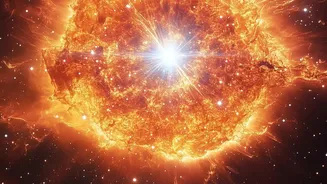
to nearly the speed of light. These high-energy particles are launched across the universe by some of its most violent events: exploding stars (supernovae), supermassive black holes, and colliding galaxies. After travelling for potentially millions of years, this 'bombardment' collides with Earth's atmosphere, creating a cascade of secondary particles that can reach the ground.
Cosmic Messengers and Hazards
Monitoring cosmic rays is crucial for two main reasons: they are both valuable messengers and potential hazards. On one hand, they are a direct sample of matter from outside our solar system, carrying clues about their violent origins. Studying them gives us a unique window into extreme astrophysical processes that are otherwise impossible to access. On the other hand, this constant radiation can be a problem. While Earth's atmosphere and magnetic field protect life on the surface, cosmic rays pose a risk to astronauts in space and can interfere with sensitive electronics, causing glitches in satellites and other machinery. Some studies even explore their potential influence on cloud formation and lightning.
Not Your Average Telescope
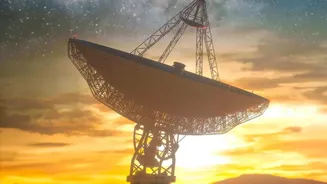
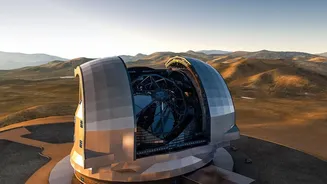
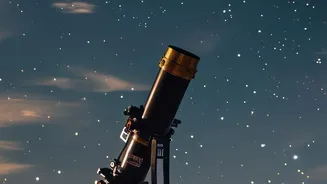
When we hear 'telescope', we think of mirrors and lenses. But detecting cosmic rays requires a completely different kind of instrument. Because the primary particles rarely make it to the ground, scientists study the 'extensive air showers' of secondary particles they create. Observatories are often massive arrays spread over huge areas. For instance, the Pierre Auger Observatory in Argentina covers 3,000 square kilometres with 1,660 water-filled tanks. When shower particles pass through the water, they create a faint flash of light called Cherenkov radiation, which sensitive detectors pick up. This is complemented by 'fluorescence detectors' that watch for the faint ultraviolet light the showers produce high in the atmosphere. Other observatories, like the IceCube in Antarctica, use a cubic kilometre of clear ice as their detector, watching for interactions from neutrinos, which are often produced alongside cosmic rays.
India’s Cosmic Quest
India has a long and distinguished history in cosmic ray research, stretching back to the 1940s with pioneering work by scientists like Homi Bhabha and Vikram Sarabhai. This legacy continues today. The GRAPES-3 (Gamma Ray Astronomy PeV EnergieS) experiment in Ooty is a world-class facility that studies cosmic ray showers with a large array of scintillator detectors and muon detectors. Another key site is the High Altitude Gamma Ray (HAGAR) telescope in Hanle, Ladakh, located at over 4,200 metres to get a clearer view of the Cherenkov light produced by cosmic rays. These facilities ensure India remains at the forefront of tackling some of the biggest mysteries in astrophysics.
Unlocking the Universe's Secrets
The ultimate goal of this global effort is to answer fundamental questions that have puzzled physicists for over a century. Where exactly do the most energetic cosmic rays come from? What precise mechanism accelerates them to such incredible speeds? By measuring the energy, direction, and composition of these particles, scientists can piece together the puzzle. In 2017, the Pierre Auger Observatory provided the first strong evidence that the highest-energy cosmic rays come from outside our own galaxy. Such discoveries, which required decades of continuous monitoring, slowly pull back the curtain on the most powerful events happening across the universe, revealing the nature of matter and energy at their most extreme.