




The Real Problem with Your Office Chair
Humans are designed for movement, but the modern workday often involves spending an average of seven to ten hours sitting. This prolonged static posture can lead to significant physical strain. When you sit for extended periods, your hip flexors shorten
and tighten, while your glute muscles can become inactive or 'turned off'. This combination creates an imbalance that pulls on your lower back, contributing to pain. Simultaneously, we often adopt a hunched-forward posture, rounding the upper back (thoracic spine) and shoulders. This can restrict movement in the mid-back, forcing the neck and shoulders to compensate, which often leads to tension headaches and shoulder discomfort. Over time, these muscle adhesions and postural habits can reduce your joints' range of motion and solidify poor posture.
Mobility: Your First Line of Defence
The antidote to stillness is movement. Mobility is your ability to actively move your joints through their full, intended range of motion. Unlike passive stretching where you hold a position, mobility drills are active movements that warm up joints and muscles, improve circulation, and restore healthy movement patterns. For desk workers, focusing on thoracic spine and hip mobility is crucial. Improving rotation and extension in your upper back can alleviate strain on your neck and lower back, while opening up your hips can counteract the negative effects of sitting. A few minutes of targeted drills can make a world of difference.
Three Simple Mobility Drills for Your Workday
You don't need a gym to get started. These exercises can be done at your desk or in a small open space. Seated Cat-Cow: This move brings flexibility back to your entire spine. Sit tall at the edge of your chair with feet flat. On an inhale, arch your back, lifting your chest and looking slightly up. On an exhale, round your spine, dropping your chin to your chest. Repeat for 8-10 slow, controlled reps. Seated Thoracic Rotations: To undo the 'hunch', sit tall and cross your arms over your chest. Keeping your hips still, slowly rotate your torso to the right as far as is comfortable. Pause, return to centre, and rotate to the left. This gentle twist helps restore rotational mobility to your mid-back. Half-Kneeling Hip Flexor Stretch: Step away from your chair and kneel on one knee (use a cushion if needed). Place your other foot flat on the floor in front of you. Gently tuck your pelvis and shift your hips forward until you feel a stretch in the front of the hip of your kneeling leg. Raise the arm on the same side for a deeper stretch. Hold for 30 seconds and switch sides.
Meet Your New Best Friend: The Foam Roller
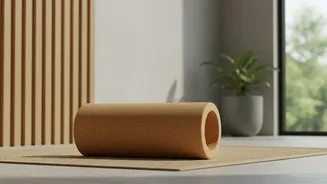
A foam roller is a simple, cylindrical tool used for self-myofascial release (SMR), which is essentially a form of self-massage. By applying pressure to specific muscles, you can help release knots and tension in the fascia, the connective tissue that surrounds your muscles. This process helps alleviate muscle stiffness, improve blood flow, and increase flexibility and range of motion. For those stuck at a desk, a foam roller is a powerful and affordable tool for targeting chronic tightness in the hips, back, and shoulders.
Essential Foam Rolling Moves for Desk Workers
Start slowly and gently; if you feel sharp pain, ease off the pressure. Focus on your muscles, not your bones or joints. Glutes and Hips: Sit on the foam roller with one foot crossed over the opposite knee in a figure-four position. Gently lean into the hip of the crossed leg, rolling slowly back and forth to find and release tight spots. This helps address the glute inactivity and hip tightness from sitting. Thoracic Spine (Upper Back): Lie with the foam roller horizontally across your upper back, just below your shoulder blades. Support your head with your hands and lift your hips off the floor. Use your feet to slowly roll up and down your mid to upper back, avoiding your neck and lower back. You can add a gentle extension by leaning back over the roller. Quadriceps: Prolonged sitting can also create tightness in the front of your thighs. Lie face down and place the roller under your quads. Support yourself on your forearms and roll from the bottom of your hip to the top of your knee.