



The Sun’s Hidden Temper
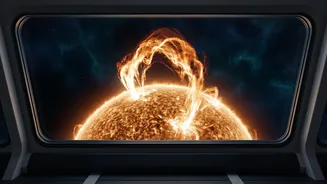
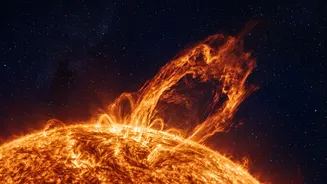
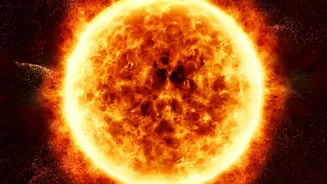
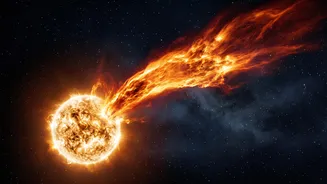
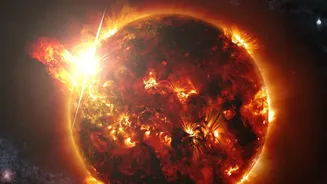
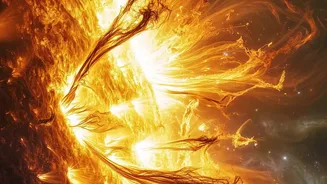
The Sun, our life-giving star, has a volatile side. It constantly expels a stream of charged particles known as the solar wind. Occasionally, it unleashes much more violent eruptions: solar flares and coronal mass ejections (CMEs). These events send massive
clouds of plasma and radiation hurtling through space. If Earth is in the path of one of these storms, the consequences can be severe. The interaction with our planet's magnetic field can induce powerful currents in our infrastructure, threatening to overload power grids and cause widespread blackouts. For the thousands of satellites orbiting above, this space weather can damage electronics, degrade solar panels, and disrupt the GPS, communication, and financial services we rely on every day.
The Old Guard of Prediction
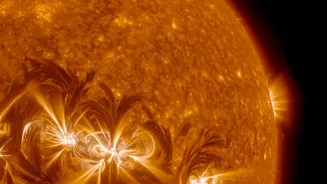
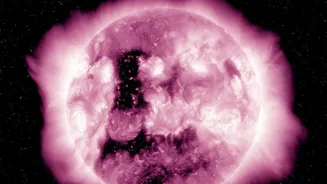
Predicting space weather has traditionally been a major challenge. For years, scientists have relied on monitoring the Sun's surface with satellites and telescopes. They watch for the formation and complexity of sunspots—dark, magnetically intense areas that are the main source of solar flares and CMEs. By observing these active regions, forecasters can make probabilistic judgments about when a flare might occur. However, this method is more like a weather forecast that says there's a 'chance of rain' rather than a precise warning. It provides valuable insight but often lacks the lead time and specificity needed to fully protect sensitive systems on Earth and in orbit. The lead time can be short, sometimes only offering a brief window after an eruption has already happened.
Enter the AI Forecaster
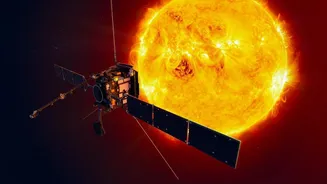
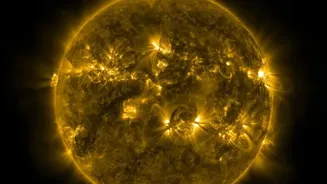
This is where artificial intelligence is beginning to change the game. Researchers are now developing sophisticated AI models that can analyze vast amounts of solar data far more efficiently than humans. Instead of just looking at the surface, these models can detect subtle, hidden signals that precede the formation of dangerous active regions. By training AI on years of data from observatories like NASA's Solar Dynamics Observatory, scientists are creating systems that can recognize the faint precursors to solar storms. This moves prediction from a reactive to a proactive science, offering the potential for longer and more accurate warnings.
Training AI for Cosmic Weather
Several promising AI models are leading the charge. A system called DAGGER (Deep Learning Geomagnetic Perturbation), developed with NASA support, can predict where a solar storm will strike on Earth with 30 minutes of advance warning. It does this by analyzing real-time measurements of the solar wind and forecasting its impact on Earth's magnetic field. Another model, EarlyDetect, uses a different approach. Developed by a team led by the New Jersey Institute of Technology, it analyzes the Sun's acoustic vibrations and magnetic fields to predict the emergence of an active region nearly nine hours before it becomes visible. This model uses a Transformer architecture, the same technology behind popular large language models, to learn patterns in solar data instead of human language. These systems sift through complex data, identifying patterns that are invisible to traditional analysis, essentially providing a 'siren' for space weather.
The Road Ahead
While the progress is exciting, AI-powered solar storm prediction is still an evolving field. The 30-minute warning from a model like DAGGER, while crucial, provides just enough time for automated systems to safeguard grids or for satellite operators to take protective measures. The nine-hour forecast from EarlyDetect offers a more strategic advantage, allowing for more thorough preparation. The ultimate goal is to integrate these different AI approaches into a comprehensive forecasting system that provides reliable, long-range predictions. As our reliance on technology deepens, so does our vulnerability to the Sun's whims. The development of these AI tools is not just a scientific curiosity; it is a critical step in building a more resilient infrastructure for a future that is increasingly connected, both on Earth and in space.