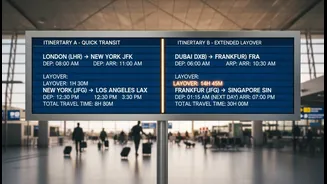









What Are Self-Transfer Flights?
A self-transfer, also known as a “split-ticket” or “self-connecting” itinerary, is when a traveller books two or more separate flights to get to their final destination. Instead of one ticket from Mumbai to New York with a layover in Dubai, for example,
you might book one ticket from Mumbai to Dubai and a completely separate ticket on a different airline from Dubai to New York. This is often done to find cheaper fares by combining airlines that don't have partnership agreements. Unlike a traditional connection booked on a single ticket, where the airline is responsible for getting you to your final destination, a self-transfer makes you the travel agent. You are responsible for everything in between, including collecting and re-checking baggage, clearing immigration, and making it to the next gate on time.
The High Stakes of a Missed Connection
The primary risk of a self-transfer is a delay in your first flight. If you book a single itinerary, the airline is obligated to rebook you on the next available flight at no extra cost if a delay causes you to miss your connection. With separate tickets, however, the second airline has no such obligation. From their perspective, you are simply a no-show. This means you could be forced to buy a new, often very expensive, last-minute ticket to continue your journey. Furthermore, you are responsible for transferring your own checked luggage. This involves collecting your bags, potentially clearing customs, checking them in with the next airline, and going through security again—a time-consuming process that adds to the risk of missing your flight. Experts recommend leaving a very generous buffer between self-transfer flights, often four to six hours or even more for international transfers.
Why Standard Travel Insurance Often Falls Short
Many travellers assume their travel insurance will protect them, but this is a common and costly misconception. Most standard travel insurance policies are written with single-ticket journeys in mind. Their "missed connection" coverage is often designed for scenarios where an airline-caused delay on one leg of a unified itinerary causes you to miss the next leg. Because self-transfers involve separate contracts with each airline, insurers often don't cover the failure of one contract to align with another. The fine print may specifically exclude self-connections or have definitions of "missed connection" that only apply to tours, cruises, or single-ticket itineraries. You are not missing a connection in the eyes of the insurer; you are simply late for an entirely separate trip.
When You Might Be Covered
Coverage is not entirely impossible, but it depends heavily on the specific policy wording and the reason for the delay. Some comprehensive travel insurance plans with a specific 'Missed Connection' benefit may offer protection if a common carrier (like your first airline) is delayed for a significant, specified period—often three to six hours—due to a covered reason like mechanical failure or severe weather. In this case, the insurance might reimburse you for the additional transportation costs to catch up to your destination. However, these benefits often come with coverage caps that may not be enough to cover the cost of a last-minute international flight. Shorter delays that still cause you to miss your flight would likely not be covered. The key is to read the policy's Certificate of Insurance carefully before you buy, paying close attention to the definitions and exclusions for trip delays and missed connections.
Smarter Alternatives for Protection
If you plan to book a self-transfer itinerary, you have a few options to mitigate the risk. The simplest is to plan for an extremely long layover, perhaps even an overnight stay, which turns the risk into a planned part of your trip. Another option is to book through a third-party travel agency that offers its own connection guarantee. These services, while sometimes adding to the cost, promise to rebook you if a delay causes you to miss a connection they packaged together. Some insurance providers also offer specific 'Missed Connection' add-ons or plans designed for more complex itineraries, but you must verify that they explicitly cover self-transfers. Finally, some premium credit cards may offer travel insurance that covers separately ticketed journeys, but again, it's crucial to confirm the specifics of the coverage.