



First, A Quick Refresher
Before we travel to Venus, let’s quickly define our terms here on Earth. A ‘day’ is the time it takes for a planet to complete one full rotation on its axis. For Earth, that’s about 24 hours. A ‘year’ is the time it takes for a planet to complete one full orbit
around the Sun. For us, that’s approximately 365 days. We are used to a simple rhythm: many short days fit into one long year. This fundamental cycle governs our seasons, our sleep, and our lives. But the universe doesn't always play by Earth’s rules, and Venus is a prime example of a planet with its own, very different, sense of time.
The Venusian Time Warp
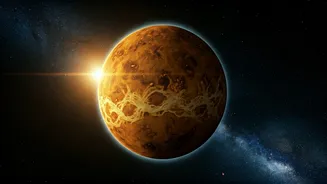
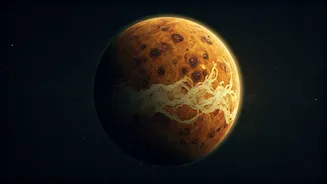
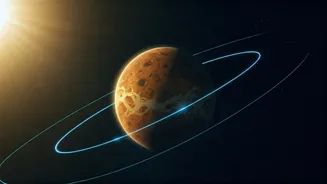
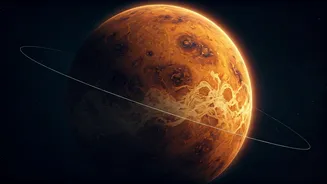
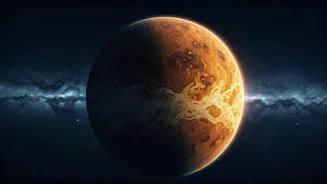
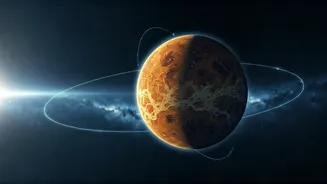
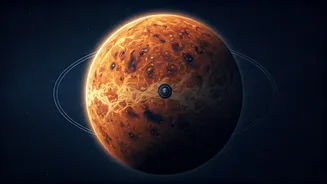
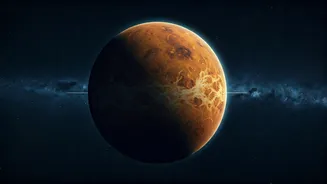
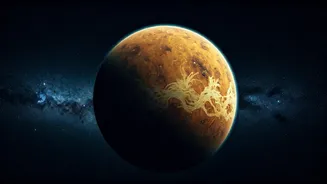
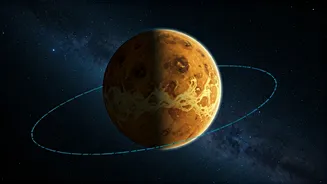
Now, let's look at Venus. It completes one full orbit around the Sun in about 225 Earth days. So, a Venusian year is 225 Earth days long—significantly shorter than our own. Here’s where it gets strange. Venus rotates on its axis incredibly slowly. One full rotation, or a sidereal day, takes approximately 243 Earth days. Let that sink in: it takes longer for Venus to spin once on its axis than it does for it to travel all the way around the Sun. This is the core of the paradox. A single Venusian day (243 Earth days) is longer than a Venusian year (225 Earth days). You would celebrate your next birthday before the planet even finished a single spin.
Why The Incredibly Slow Spin?
So, why is Venus such a slow spinner? Scientists believe its thick, heavy atmosphere plays a major role. The Venusian atmosphere is about 90 times denser than Earth's and is in a state of 'super-rotation,' whipping around the planet in just four Earth days. This creates an immense amount of friction and tidal drag on the planet's surface, acting like a powerful brake that has slowed its rotation over billions of years. Another peculiar feature is that Venus spins backward. Unlike Earth and most other planets in our solar system, it has a retrograde rotation, meaning the Sun rises in the west and sets in the east. Some theories suggest this could be the result of a massive asteroid collision deep in its past, which literally knocked it into a reverse, slow spin.
Sunrise to Sunrise Is Different
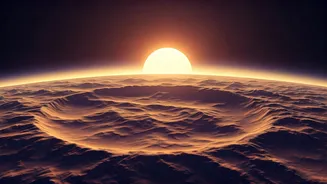
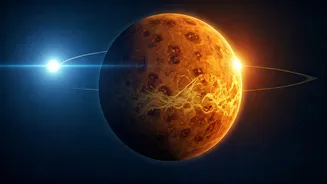
To add another layer of complexity, the length of a day can also be measured from one sunrise to the next. This is called a ‘solar day’. Because Venus rotates backward while orbiting the Sun, these two motions work against each other in a unique way. The result is that a solar day on Venus is actually much shorter than its sidereal day. From one sunrise to the next, it would take about 117 Earth days. So, while a full spin takes 243 days, you’d see the Sun rise roughly twice during a Venusian year. It's a confusing clock, but it’s how time works on the second planet from the Sun.
What This Means For The Planet
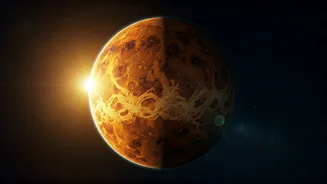
This sluggish rotation has profound consequences for Venus. With such a long day, one side of the planet bakes in continuous sunlight for months, while the other side is plunged into an equally long night. You might expect the night side to become incredibly cold, but this is where Venus's hellish atmosphere takes over. The thick blanket of carbon dioxide traps heat so effectively in a runaway greenhouse effect that temperatures remain scorching hot—around 465°C—across the entire planet, day and night. The long days and extreme heat, combined with clouds of sulfuric acid, make Venus one of the most inhospitable places in our solar system.