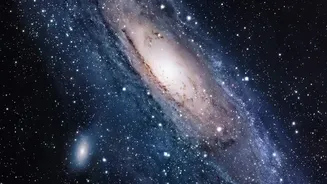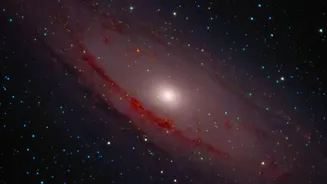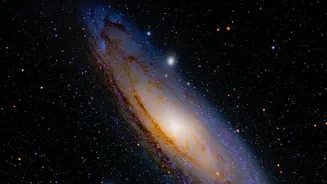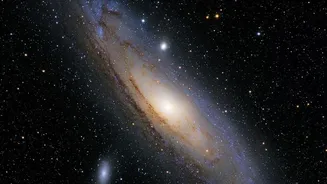


A Universe in a Smudge of Light
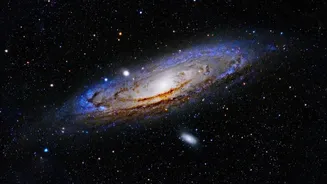
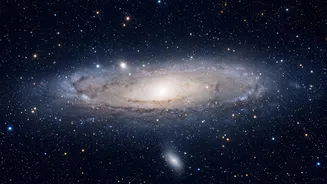
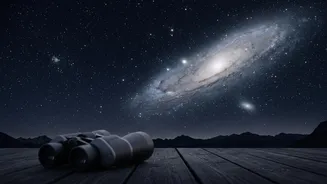
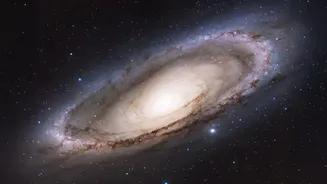
The Andromeda galaxy, also known as Messier 31 or M31, holds a unique distinction in stargazing: it is the farthest object that can be consistently seen with the naked eye and is a spectacular sight in basic binoculars. While our own Milky Way is teeming
with star clusters and nebulae, Andromeda is a completely separate galaxy. It is a sprawling metropolis of roughly a trillion stars, more than double the estimated population of our own. Its distance is almost incomprehensible; the light reaching your eyes tonight began its journey around 2.5 million years ago, when early human ancestors roamed the Earth. Every other star you see in the sky with your unaided eye is a resident of our own local Milky Way galaxy. Andromeda is the first and only stop beyond our galactic borders that is accessible without a powerful telescope.
The Secret: A Brilliant Galactic Powerhouse
How can an object so far away be visible at all? The answer lies in the combination of its immense size and brightness. Andromeda isn’t just a galaxy; it is the largest member of our Local Group of galaxies. While its distance is vast, its sheer scale is even more impressive. If our eyes were sensitive enough to see its full extent, the galaxy would appear more than six times wider than the full moon in our sky. But what we see is the glow from its intensely bright central core. With an apparent magnitude of 3.4, it is one of the brightest deep-sky objects listed in the famous Messier catalogue. This glow is the combined light of a trillion suns, a cosmic beacon powerful enough to cross millions of light-years of empty space and still register as a faint but distinct patch to an observer on Earth.
What to Expect Through Binoculars
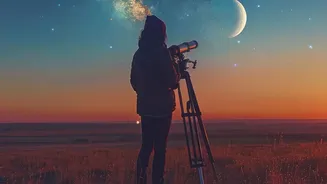
For first-time observers, the view of Andromeda through binoculars can be both underwhelming and profound. You will not see the magnificent spiral arms that grace photographs from the Hubble Space Telescope. Instead, you will see a soft, elongated, oval-shaped cloud of light. The key is to know what you are looking at. That gentle glow is not a nearby cloud in our atmosphere but a colossal island of stars. With a steady hand or a tripod, you can clearly make out its bright, concentrated nucleus and the hazy halo that fades into the blackness of space. For the best experience, find a location with minimal light pollution, allow your eyes to adapt to the darkness for at least 15 minutes, and use a technique called averted vision—looking slightly to the side of the galaxy—to make its faint outer regions pop into view.
Finding the Celestial Giant
Locating Andromeda is a rewarding challenge for any budding astronomer. The easiest way to find it is by using a prominent W-shaped constellation in the northern sky called Cassiopeia. Think of the deeper 'V' shape on one side of the 'W' as an arrow. This arrow points roughly in the direction of the Andromeda galaxy. Another method is to start from the Great Square of Pegasus, a large boxy pattern of four stars. From the star in the top-left corner of the square (Alpheratz), hop over two bright stars to its left, then look slightly above that line. In a dark sky, you'll spot it as a faint, fuzzy star. Once you have it in your sights, raise your binoculars to get a much clearer, brighter view of our nearest major galactic neighbour.
Are There Any Challengers?
While Andromeda is championed as the farthest object for casual viewing, some expert observers under exceptionally dark skies have reported glimpsing the Triangulum Galaxy (M33). It is slightly more distant, but its light is spread out over a large area, making it significantly dimmer and a much tougher target to confirm, even with good binoculars. Other, more distant objects like quasars can be seen, but they require large amateur telescopes and look no different than faint stars. This is what makes Andromeda so special. It doesn't require expensive equipment or years of experience. It is the universe's most distant welcome mat, an entire galaxy offered up for anyone with a pair of binoculars and a little curiosity.