


The Constant Drag of Low Orbit
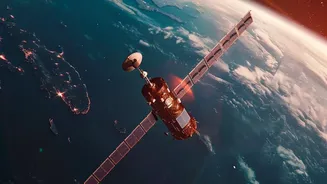
For a satellite, speed is life. To stay in orbit, it must travel at thousands of kilometres per hour, fast enough to perpetually 'fall' around the Earth. But in Low Earth Orbit (LEO), and especially in Very Low Earth Orbit (VLEO) below 450 kilometres,
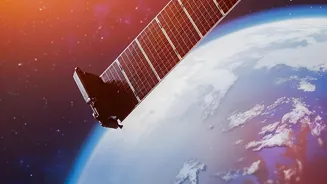
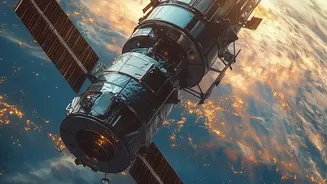
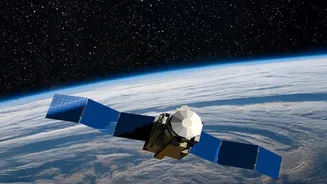
satellites are not in a perfect vacuum. They fly through the wispy, outermost traces of the atmosphere. While incredibly thin, this residual air creates friction, or drag, that acts like a constant brake. This drag forces satellites to lose altitude, eventually causing their orbits to decay. To fight this, satellites must fire thrusters to boost themselves back up, a process that consumes precious onboard fuel. Once the fuel runs out, the mission is over. This fundamental limitation has made long-duration missions in VLEO—a highly desirable region for its proximity to Earth—nearly impossible.
A Revolutionary Idea: Breathing Air in Space
What if a satellite didn’t need to carry its own fuel? This is the transformative idea behind Air-Breathing Electric Propulsion (ABEP), a technology that sounds like science fiction but is now on the cusp of reality. Instead of fighting the atmosphere, an ABEP system uses it. The concept is elegantly simple: collect the very same atmospheric molecules that cause drag and use them as propellant. By scooping up these residual gases—mostly atomic oxygen and nitrogen at these altitudes—and feeding them into an electric thruster, the satellite can generate a continuous, gentle push to counteract the drag it experiences. The problem, in effect, becomes the solution, potentially allowing a satellite to stay in its orbit not just for years, but for as long as its electronic systems continue to function.
How It Actually Works
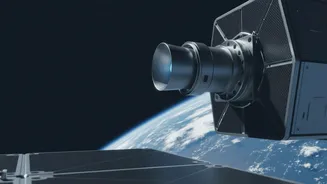
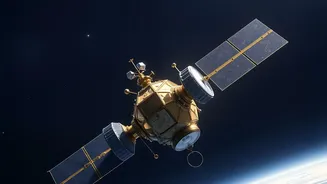
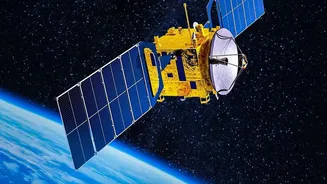
An ABEP system consists of two main components: an intake and an electric thruster. The intake is a specially designed collector at the front of the satellite that passively funnels the sparse atmospheric particles into the propulsion system as the satellite speeds along its orbit. Once collected, these captured gas molecules are channeled into the thruster. Here, electrical power, generated by the satellite's solar panels, is used to ionize the particles, stripping electrons from the atoms to create a plasma. This cloud of charged particles is then accelerated by electric and magnetic fields and expelled at high velocity. This ejection produces a small but constant thrust in the opposite direction, perfectly countering the force of atmospheric drag. The result is a highly efficient system that maintains the satellite's altitude without using a single drop of stored propellant.
The Promise of VLEO Constellations
The development of ABEP is driven by the significant advantages of operating in Very Low Earth Orbit. Being closer to the planet means Earth observation satellites can capture much higher-resolution images, and communication satellites can offer lower latency and stronger signals. However, the atmospheric drag in VLEO can be hundreds of times stronger than in higher LEO orbits, making conventional missions incredibly short and expensive. Air-breathing propulsion changes this economic equation entirely. By enabling satellites to operate for many years in these challenging altitudes, it opens the door for new business models and next-generation satellite constellations. Space agencies like the European Space Agency (ESA) have been at the forefront of this research, with successful ground tests demonstrating that the technology is feasible.
Challenges on the Path to Orbit
While the promise is immense, engineers still face several hurdles. The first is designing an intake that can efficiently collect enough particles from the incredibly rarefied atmosphere of VLEO. Another challenge is that traditional electric thrusters are designed to use a pure, noble gas like xenon. The ABEP thruster must be able to reliably ionize and accelerate a constantly changing mix of atmospheric gases, which can also be corrosive to components like the cathode. Researchers are actively developing new cathode-less designs and robust materials to overcome these issues. Proving the complete system can work reliably for years in the harsh space environment is the final step before this technology can be widely deployed.