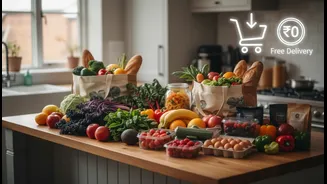







The ‘Free Delivery’ Illusion
In the fast-paced world of Bengaluru's quick commerce, platforms like Swiggy Instamart, Zepto, and Blinkit have made 10-minute deliveries a daily habit. The promise of “free delivery” is a powerful magnet, but it almost always comes with a condition:
a minimum order value. This threshold, often hovering around ₹199, is the key to the entire business model. What was once a spontaneous ₹80 order for a missing ingredient now requires a more significant purchase to avoid a delivery fee of ₹20 to ₹35. This isn't an accident; it's a carefully designed strategy to nudge you from a small, convenience-driven purchase to a larger, more profitable one for the company. The platforms are betting you'd rather add a few extra items to your cart than pay a fee that feels like a penalty.
The Psychology of Your Shopping Cart
This phenomenon is driven by a powerful psychological principle called 'loss aversion'. Studies show that humans feel the pain of a loss more intensely than the pleasure of an equivalent gain. Paying a ₹30 delivery fee feels like a direct loss. In contrast, spending an extra ₹100 on groceries to qualify for free delivery feels like you’re gaining more product for your money. You’re not losing anything; you’re just spending more to get more. This transforms the purchase from a transaction with a penalty to one with a reward. Platforms amplify this by showing progress bars like, “You’re only ₹40 away from free delivery!” This taps into our desire for goal attainment, making it feel like a mini-game you need to win. Before you know it, you've successfully 'won' free delivery but also spent twice what you intended.
The Business Behind the Basket
From the company's perspective, these minimums are essential for survival. The unit economics of delivering a single, small order are brutal. Each 10-minute delivery involves numerous costs: the delivery partner’s pay, the salary of the staff who pick and pack your items in a 'dark store', the rent for that conveniently located (and expensive) urban warehouse, and the technology that powers it all. A single ₹50 order is almost guaranteed to be a loss-maker. By encouraging a larger basket size, these platforms can spread their fixed costs across more items, pushing the order into profitability. This is why the industry has shifted away from aggressive fee waivers and focused on achieving a sustainable average order value (AOV).
How to Shop Smarter
While the convenience is undeniable, being a mindful consumer can save you from unintentional overspending. First, plan your needs. Instead of placing small, impulsive orders, try to consolidate them. A running list on your fridge or phone can help you place one larger, planned order per week. Second, consider the alternatives. For just one or two items, is the local kirana store a better option? A quick walk might be cheaper and faster than building a large online basket. Third, try 'buddying up'. If you and a neighbour both need a few things, combining your orders can help you easily meet the threshold. Finally, do the maths. Sometimes, paying the ₹30 delivery fee is cheaper than adding ₹100 worth of unplanned items to your cart. Don't let the fear of a fee trick you into spending more overall.
Is It Always a Bad Deal?
Despite the psychological nudges, these minimums aren't inherently evil. They enable a business model that provides incredible convenience. For families doing a weekly stock-up or for those times when you genuinely need several items quickly, meeting the minimum order value is a natural part of the process. The service is most valuable when your needs align with the platform's economic model. The key is to ensure the platform is serving your needs, not the other way around. The convenience of quick commerce is a major advantage of modern city life, but it pays to be aware of the subtle costs involved.