

The Moon's Hidden Sanctuaries
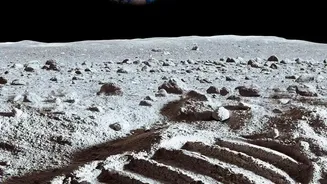
Before we can build a permanent human settlement on the Moon, we have to solve a few major problems: cosmic radiation, extreme temperature swings, and the constant threat of micrometeorite impacts. The lunar surface is a hostile environment, with no atmosphere
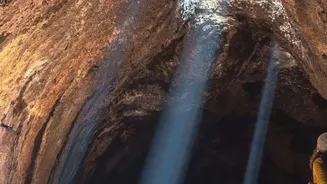
to offer protection. Over two weeks of scorching daylight can see temperatures rise dramatically, followed by two weeks of frigid darkness. The solution might be hiding in plain sight—or rather, just below the surface. The Moon is home to vast, hollow tunnels known as lava tubes, formed billions of years ago when the surface of ancient lava flows hardened while molten rock continued to flow underneath. Some of these tubes are enormous, potentially wide enough to house entire cities. Buried under thick layers of solid rock, they offer natural, built-in shielding from radiation and impacts, as well as a stable, constant temperature, making them ideal locations for future astronaut habitats.
Exploring in Absolute Darkness
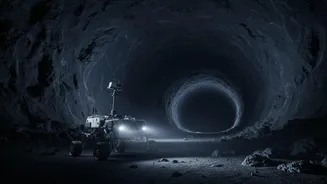
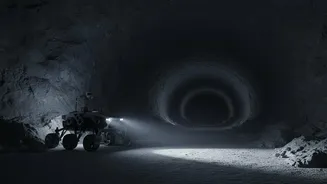
Identifying these tubes from orbit is one thing; exploring them is another challenge entirely. The environment inside a lunar lava tube is one of the most difficult imaginable for a robot. It's a world of total darkness, with no GPS to provide location data and no easy way to communicate with a lander on the surface. The terrain is unpredictable, uneven, and potentially littered with sharp rocks and deep pits. A rover can't simply be driven by an operator on Earth due to significant time delays. It must be able to think for itself, navigating treacherous, unknown territory completely on its own. This requires a sophisticated suite of sensors and intelligent software that can build a map of its surroundings while simultaneously tracking its own position within that new map.
The Rover's High-Tech Senses
To navigate without light or satellite positioning, rovers rely on a combination of advanced sensors. The most critical of these is LiDAR, which stands for Light Detection and Ranging. LiDAR works by shooting out pulses of laser light and measuring how long it takes for the reflections to return. By doing this thousands of times per second, the rover can build a detailed, 3D point-cloud map of the cave's interior. This is often paired with stereo cameras, which provide visual data and depth perception, much like human eyes. Another key component is the Inertial Measurement Unit, or IMU. The IMU is a device containing accelerometers and gyroscopes that constantly track the rover's motion, rotation, and orientation. While LiDAR maps the external world, the IMU tracks the rover's internal state of movement, providing crucial data on its speed and direction.
The Brain of the Operation: SLAM
The real magic happens when the data from all these sensors is fused together by a powerful algorithm known as SLAM, or Simultaneous Localization and Mapping. SLAM is what allows a robot to enter an unknown space and make sense of it. Imagine being in a pitch-black room you've never been in before. You might slowly reach out, touching walls and objects to build a mental map, while also keeping track of your own steps to know where you are in relation to what you've just touched. That's essentially what a rover does with SLAM. The algorithm takes the 3D map data from the LiDAR and combines it with the motion data from the IMU to create a coherent picture. It continuously refines the map while simultaneously pinpointing the rover's location within it, correcting for small drifts and errors to avoid getting lost.
Putting Theory to the Test
Several space agencies and private companies are actively developing and testing this technology. The European Space Agency (ESA) has studied concepts like the spherical DAEDALUS probe, designed to be lowered into a pit and roll autonomously to map the interior. Other concepts involve swarms of smaller robots that work together, creating a communication chain to relay data back to the surface. Teams have been testing rover prototypes in Earth-based lava tubes, such as those in Lanzarote, Spain, which serve as a realistic analogue for the lunar environment. Recently, NASA has also funded early research into a laser-powered drone that would be tethered to a surface rover, allowing it to fly into deep caves without carrying heavy batteries. These projects are pushing the boundaries of autonomous robotics and are a critical step toward establishing a long-term human presence beyond Earth.