





A Junkyard in Orbit
Low Earth Orbit (LEO) is more than just a gateway to the stars; it's a critical highway for modern life. Thousands of active satellites circle the globe, providing everything from GPS navigation and weather forecasting to global communications. But this
vital region is also becoming a junkyard. Decades of space activity have left behind a cloud of debris, including spent rocket stages, dead satellites, and fragments from past collisions. NASA tracks tens of thousands of objects larger than a softball, while millions of smaller, untraceable pieces whip around the planet at speeds exceeding 17,500 miles per hour. At these velocities, a collision with even a small fragment can be catastrophic, destroying a multi-million-dollar satellite and creating thousands of new pieces of debris. This sets the stage for a dreaded chain reaction, known as the Kessler Syndrome, which could render LEO unusable for generations.
The Magnetic Grapple Solution
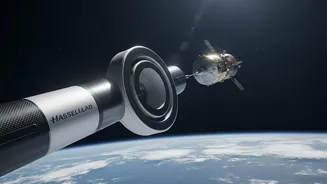
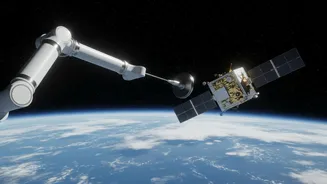
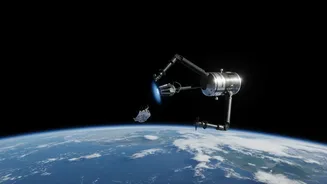
Cleaning up this mess presents an enormous engineering challenge. Traditional methods like nets or harpoons can be effective, but they risk making the problem worse if they fail to capture a tumbling object correctly, potentially breaking it apart. This is where magnetic capture comes in as an elegant and promising alternative. The concept involves a 'servicer' spacecraft equipped with a powerful electromagnet. This probe would rendezvous with a defunct satellite, and instead of a risky physical grab, it would use its magnetic field to latch on. This method is particularly effective for satellites that are spinning uncontrollably, as a non-contact or simple magnetic dock is much safer than trying to snag it with a robotic arm. Companies like Astroscale have demonstrated this technology in orbit, showing how a servicer can approach, magnetically connect to, and control a target object.
Designing for De-orbit
One of the biggest limitations of magnetic retrieval is that many existing satellites and debris fragments are not magnetic. A large portion of satellite construction uses lightweight, non-ferromagnetic materials like aluminum. To address this, the space industry is shifting toward a 'design for removal' philosophy. New satellites are being built with a standardized magnetic docking plate—a simple, ferromagnetic target that a future cleanup probe can easily latch onto. By planning for a satellite's end-of-life from the very beginning, operators can ensure their assets can be safely and efficiently removed. This forward-thinking approach transforms the complex challenge of capturing uncooperative debris into a straightforward docking maneuver, making magnetic retrieval a highly viable long-term solution for maintaining orbital sustainability.
Advanced Concepts and Challenges
While simple magnetic grappling is ideal for prepared satellites, researchers are also developing more advanced techniques for uncooperative targets. Some concepts involve using powerful, rotating magnetic fields to induce eddy currents within any conductive object, effectively turning the piece of debris into a temporary electromagnet. This would allow a probe to manipulate and stabilize a tumbling, non-magnetic object without ever touching it, a process known as dexterous magnetic manipulation. Despite these innovations, significant hurdles remain. The cost of a single active debris removal mission is substantial, and the sheer volume of existing junk is daunting. Furthermore, the legal and geopolitical questions of who is responsible for legacy debris and who pays for its removal are as complex as the engineering challenges themselves.