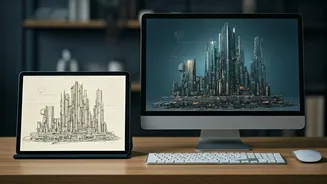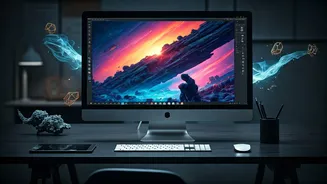





The Old Way vs. The New AI
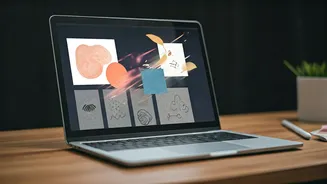
For decades, creating a mood board was a manual, time-consuming process. Designers and creative directors would spend hours, sometimes days, scouring stock photo sites, magazines, and social media platforms like Pinterest to find images that matched a client's
brief. The goal was to assemble a collage that captured a specific feeling, aesthetic, or direction. It was a process of translation and approximation, trying to find existing visuals to match a new idea.Now, generative artificial intelligence has flipped that process on its head. Instead of searching for images that fit an idea, creatives can now generate entirely new images from the idea itself. Platforms like Midjourney, DALL-E 3, and Stable Diffusion are at the forefront of this revolution. They use complex algorithms to interpret written prompts and produce high-quality, original visuals that align with the user's text.
From a Simple Brief to a Visual World
The magic lies in the text prompt. What was once a simple creative brief shared between humans is now a direct command for a machine. Instead of writing, “We’re looking for a warm, rustic, and slightly modern feel,” a designer can now prompt an AI with a far more descriptive command.Consider this brief: “Create a high-fidelity mood board for a new coffee brand. The aesthetic is ‘Scandinavian minimalism meets Mumbai monsoon.’ Show a minimalist cafe interior with teak wood furniture, soft grey walls, brass lighting fixtures, and large windows showing a rainy street scene outside. The mood should be cosy, serene, and sophisticated.”Within minutes, an AI can generate a dozen variations of this scene. It won’t just find pictures of cafes; it will create the specific cafe described, capturing the nuanced blend of styles, lighting, and mood. This isn't just finding images; it's visual ideation at lightning speed.
The “Instant” Advantage: Speed and Clarity
The word “instantly” in the headline is, of course, a slight exaggeration. It takes minutes, not milliseconds. But compared to the old way, it’s a seismic shift in speed. The primary advantage is the ability to rapidly iterate. Don’t like the lighting? Add “golden hour light” to the prompt. Want a different texture? Specify “unpolished concrete floors.” This ability to tweak and regenerate allows creative teams to explore a vast range of visual directions in a single afternoon.This speed translates into a powerful communication tool. It’s often difficult for clients to visualise a concept from words alone. By generating a mood board directly from the brief, designers can get everyone on the same page from day one. It eliminates ambiguity and reduces the number of revisions needed down the line, saving both time and money.
The Art of the Prompt
The quality of the output depends entirely on the quality of the input. Learning to “speak AI” is becoming a new, essential skill for creatives. A vague prompt like “a cool car” will yield generic results. A great prompt is descriptive and layered.To get high-fidelity results, you must be specific. Include details about the subject, the setting, the colour palette, the lighting (e.g., “dramatic backlighting,” “soft morning glow”), the camera angle (“wide shot,” “macro detail”), and the overall style (“photorealistic,” “in the style of a Wes Anderson film,” “impressionist painting”). The AI is a powerful instrument, but the designer is the one who must know how to play it.
Curation Is Still King
This technology is not a replacement for creative professionals. While an AI can generate hundreds of beautiful images, it lacks taste, strategy, and context. It doesn’t understand the client's business goals or the target audience. The designer's role is shifting from image hunter to expert curator and editor.The real work begins after the images are generated. A designer must still select the best options, refine the colour story, and assemble the disparate images into a cohesive and strategic mood board that tells a compelling story. The AI provides the raw material; the human provides the vision, the narrative, and the purpose. It’s a powerful partnership, augmenting human creativity rather than rendering it obsolete.