






A Mission to a Metal World
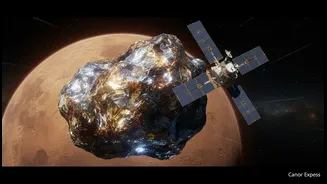
NASA's Psyche spacecraft is on a long journey to a truly unique destination: a metal-rich asteroid named 16 Psyche. Launched in October 2023, the mission's goal is to investigate what is believed to be the exposed iron core of a planetesimal, a building
block of a planet from the early solar system. By studying it up close, scientists hope to learn more about how planets like our own Earth formed. But to get there—a journey that will see it arrive in 2029—the spacecraft needs to be in perfect working order, and it requires a little help from gravity.
The Martian Slingshot
On May 15, 2026, the Psyche spacecraft performed a carefully choreographed flyby of Mars. The main purpose was a 'gravity assist'—using the planet's gravitational pull to slingshot the craft, increasing its speed and adjusting its trajectory toward the asteroid belt without burning precious fuel. However, mission planners at NASA saw this as a golden opportunity. This close encounter with a well-studied planet was the perfect chance to test and calibrate the spacecraft's suite of sensitive scientific instruments before it reaches its final, unknown destination.
A Veteran Orbiter Lends a Hand
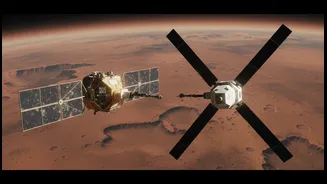
This is where the European Space Agency's (ESA) Mars Express comes in. Having orbited the Red Planet for two decades, Mars Express and its cameras have provided a wealth of data, creating highly detailed maps of the Martian surface. Realizing their spacecraft would be in the same neighbourhood, teams from NASA and ESA decided to work together. It was a brilliant idea: have the new kid on the block, Psyche, take pictures of Mars and compare them to the 'ground truth' provided by the seasoned veteran, Mars Express. Weeks in advance, the mission teams exchanged trajectory data and timelines to ensure they could photograph the same regions of Mars at almost the same time.
The Importance of Calibration
Calibrating a space camera is crucial for ensuring scientific accuracy. Think of it like setting the white balance on your phone's camera, but infinitely more complex and important. Scientists need to know exactly how the camera's sensors respond to different colours and brightness levels. If the calibration is off, the data collected at the asteroid Psyche could be misinterpreted. By imaging a known target like Mars, whose surface composition has been extensively studied, scientists can fine-tune Psyche's imagers. They can see if a region known to be a specific type of reddish rock actually appears that way in Psyche's images. If not, they can adjust the settings and data processing to correct it.
A Symphony of Data
During the coordinated event, Mars Express took images from its orbit at an altitude of about 6,000 kilometres. Just under two hours later, Psyche, having already made its closest approach and now receding from the planet, captured the same landscape, a region called Noachis Terra, from an altitude of around 41,000 kilometres. Though taken from different distances and angles, comparing these synchronised images provides an invaluable data set. Scientists can now meticulously cross-reference the readings from Psyche’s new multispectral imager with the well-established performance of the camera on Mars Express, ensuring Psyche's vision will be sharp and accurate when it matters most.
Ready for the Main Event
This successful collaboration was more than just a cool interplanetary photo-op; it was a vital dress rehearsal. The flyby confirmed that not only Psyche's imagers, but its full array of instruments—including its magnetometer and gamma-ray spectrometer—are functioning perfectly after years in deep space. The 'icing on the cake', as one mission leader called it, has boosted confidence across the board. This Martian pit stop has ensured that when Psyche finally arrives at its metal world in 2029, it will be fully prepared to unlock the secrets of this planetary core.