






From Faint Dot to Dynamic World
Before 2015, our best view of Pluto was a fuzzy speck captured by the Hubble Space Telescope. Scientists largely assumed it was a geologically dead world, frozen solid by temperatures of nearly -230 degrees Celsius. Its great distance and small size suggested
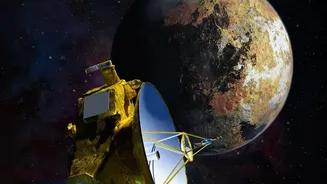
it would have lost any internal heat from its formation billions of years ago. The arrival of NASA's New Horizons spacecraft dramatically changed that perception. The first high-resolution images revealed towering mountains of water ice, vast plains of frozen nitrogen, and a stunning variety of terrains that pointed not to a dead world, but a surprisingly active one.
A Landscape of Ice Volcanoes
Among the most startling discoveries was evidence of widespread cryovolcanism—volcanoes that erupt icy slush instead of molten rock. Researchers identified a region dominated by enormous domes, some up to seven kilometers tall and 150 kilometers across. One prominent feature, Wright Mons, is comparable in volume to Mauna Loa, one of Earth's largest volcanoes. These are not volcanoes in the traditional sense. Instead of rock, they appear to have spewed a viscous, toothpaste-like mixture of water ice and other substances like ammonia, which lowers the freezing point of water. This activity has resurfaced vast areas, suggesting a source of internal heat, likely from the slow decay of radioactive elements within Pluto's core.
The Beating Heart of Pluto
At the center of Pluto's geological story is Sputnik Planitia, the western lobe of the famous heart-shaped feature on its surface. This is not solid ground but a colossal glacier of nitrogen ice, larger than Texas and Oklahoma combined. This vast basin is strikingly free of impact craters, indicating its surface is incredibly young—perhaps no more than 10 million years old and possibly much less. The surface is broken into city-sized polygonal cells that are constantly, slowly churning in a process of solid-state convection, powered by modest heat from below. This constant renewal makes Sputnik Planitia one of the youngest surfaces in the entire solar system.
Whispers of Liquid and Signs of Change
The complexity doesn't stop there. Recent analysis of New Horizons imagery from August 2026 suggests that liquid nitrogen may have recently flowed, and could still occasionally seep, onto the surface. Dark streaks seen along the boundaries of Sputnik Planitia's convection cells resemble features on Earth's glaciers caused by meltwater. While Pluto’s atmosphere is too thin for nitrogen rain, this suggests a subsurface source of liquid nitrogen is welling up through cracks. Further evidence of Pluto's dynamic nature comes from the discovery of massive landslides along the steep walls of impact craters, another sign that the surface is actively evolving.
A Hidden Ocean?
The presence of so much geological activity—from cryovolcanoes to flowing glaciers—raises a monumental question: what is powering it all? The leading theory is that Pluto retains more internal heat than previously thought, perhaps enough to sustain a vast ocean of liquid water mixed with ammonia deep beneath its icy crust. The formation of Sputnik Planitia in an ancient impact basin may have thinned the crust enough to allow this subsurface ocean to well up, creating a mass concentration that literally caused Pluto's entire surface to shift over geological time. While not yet proven, the existence of a subsurface ocean would fundamentally rewrite our understanding of worlds in the cold, dark Kuiper Belt.