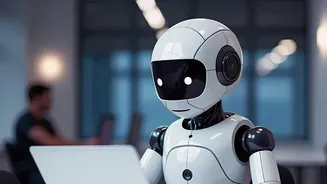






AI tutors are being hailed as the future of education, offering every student a personalised guide. But what if this digital helper has a hidden cost? New research suggests these tools might actually discourage the very engagement they aim to foster.
The Promise of a Personalised Mentor
The dream of a personal tutor for every child has long been a goal in education. In recent years, artificial intelligence has seemingly brought that dream within reach. Companies and educational institutions across India are rapidly adopting AI-powered platforms that promise to revolutionise learning. These systems can adapt to a student's pace, offer instant feedback, and provide 24/7 support. The appeal is obvious: a tireless, endlessly patient guide that personalises lessons to fit individual needs, helping students with everything from complex mathematics to learning a new language. For many, this technology represents a leap toward making quality education more accessible and effective for all, a powerful tool to supplement and support the work of human teachers.
A Surprising Drop in Engagement
Despite the optimism, recent studies are beginning to reveal a more complex picture. A notable study from the University of Maryland, for example, delivered surprising results. In a semester-long trial with over 2,000 undergraduate students, those given access to a course-integrated AI tutor not only recorded lower final grades but also engaged less with online learning activities. Specifically, students with AI help visited course pages less, participated less in discussions, and completed fewer assignments and quizzes. This wasn't an isolated finding. A Stanford University study on elementary school students found that, despite having scheduled time, average weekly use of an AI tutor was shockingly low—sometimes only a few minutes—and that access alone did not lead to meaningful engagement or improved outcomes.
When Help Becomes a Hindrance
So, why would a tool designed to help end up hindering learning? Researchers suggest a few key reasons. One major factor is the risk of 'cognitive laziness'. When an AI provides answers too quickly and easily, it can short-circuit the learning process. The struggle to work through a problem is where deep understanding is often built. If a student can simply get the solution without the effort, they miss the chance to develop critical thinking and problem-solving skills. One 2025 study found that students with unrestricted access to a general-purpose AI actually performed worse on later tests when the AI was removed, suggesting they used the tool as a 'crutch' rather than a learning aid. This creates an illusion of comprehension without the durable knowledge to back it up.
The Irreplaceable Human Element
This growing body of research highlights what teachers and parents have long understood: learning is a deeply social and emotional process. An AI tutor, no matter how advanced, cannot replicate the empathy, encouragement, and nuanced feedback of a human educator. A human teacher can spot the subtle signs of frustration or confusion, offer encouragement, and connect a lesson to a student's personal interests. A University of Cambridge experiment found that while an AI tutor kept students working, a human tutor was far better at making a difficult task feel manageable and less stressful. This human connection is crucial for building resilience and fostering a genuine love of learning, aspects that current AI struggles to address.
Finding the Right Balance for the Future
This doesn't mean AI has no place in the classroom. The consensus among experts is not to abandon the technology, but to be more thoughtful about its implementation. The most effective models appear to be hybrid approaches, where AI acts as a co-pilot for a human teacher. For instance, AI can handle personalising practice problems while the teacher focuses on higher-level instruction and mentorship. Furthermore, designing AI tutors with 'pedagogical guardrails'—like providing hints instead of direct answers—has been shown to mitigate the negative effects on learning. As India continues its digital education push, the focus must shift from simply providing access to designing systems that truly support, rather than replace, the essential cognitive work of learning.