



A New Kind of Vision
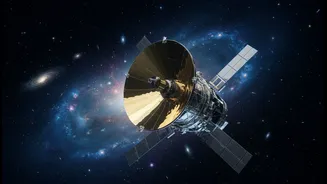
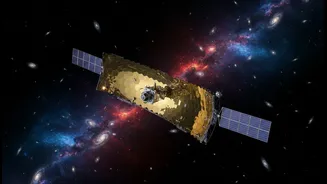
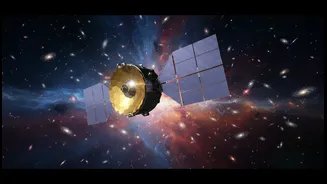
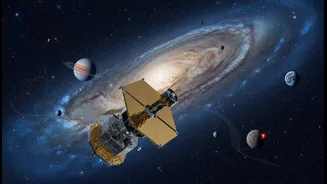
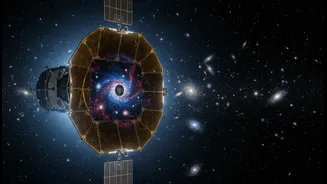
Scheduled for launch around August 30, 2026, the Nancy Grace Roman Space Telescope is the next great observatory in NASA’s fleet, but it offers a crucial difference. While its predecessors like the Hubble and James Webb space telescopes provide stunningly
deep, detailed views of small patches of sky—like looking at a city through a keyhole—Roman is built for the bigger picture. With a mirror the same size as Hubble's, its main instrument can capture an area of the sky at least 100 times larger in a single snapshot. This makes it a survey powerhouse, capable of mapping vast cosmic territories with incredible speed and precision. Having recently arrived at the Kennedy Space Center in Florida for its final pre-launch preparations, Roman is not meant to replace Hubble or Webb, but to complement them. It will act as a grand mapmaker, identifying countless new targets for its sister telescopes to investigate in greater detail. This shift from focused staring to wide-angle surveying is set to transform entire fields of astrophysics.
Seeing the Invisible Universe
One of Roman’s primary targets is dark matter, the mysterious substance that makes up about 85% of the matter in the universe but remains completely invisible. While we cannot see it directly, we can see its effects. Roman will hunt for dark matter by using a technique predicted by Albert Einstein called gravitational lensing. When a massive object like a galaxy or a clump of dark matter sits in front of a more distant galaxy, its gravity bends and magnifies the background light, creating distorted arcs and rings. Roman’s wide-field view is expected to find a staggering 160,000 of these 'strong lenses'—far more than the few hundred studied to date. By analyzing the precise shape of these distortions across thousands of galaxies, scientists can create detailed maps of how dark matter is distributed. This will help answer more nuanced questions, such as whether dark matter is 'cold' (made of slow-moving particles) or 'warm' (made of faster ones), by revealing how it has clumped together to form the cosmic structures we see today.
A Galactic Planet Census
Roman is poised to completely rewrite our catalogue of exoplanets—worlds orbiting other stars. Since the 1990s, astronomers have confirmed the existence of just over 6,000 exoplanets. Roman is projected to find around 100,000. This monumental leap comes from its ability to conduct a galactic census. Unlike the Kepler mission, which focused on a nearby patch of our galactic neighbourhood, Roman will stare toward the dense, star-rich centre of the Milky Way. Using a technique called gravitational microlensing, it will watch for the brief, tiny brightening that occurs when a planet passes in front of a background star, its gravity momentarily focusing the light. This method is sensitive enough to find planets of all sizes, including those smaller than Earth and even 'rogue' planets that wander through space untethered to a star. The mission will move beyond simply asking 'how many planets are out there?' to asking 'how do planet populations change across different parts of our galaxy?' This new perspective will provide critical clues about how planetary systems form and evolve in diverse cosmic environments.
Mapping Cosmic Expansion
Beyond individual objects, Roman will map the universe on the grandest scales. Its High-Latitude Wide-Area Survey will observe hundreds of millions of distant galaxies to study the evolution of the cosmos and the force driving its accelerating expansion: dark energy. By precisely measuring the distances to galaxies and how they are clustered together, Roman will give scientists a new tool to probe the nature of this mysterious force. Is it a constant energy filling space, as Einstein proposed, or has it changed over cosmic history? The telescope’s panoramic view will allow astronomers to move from studying individual galaxies to analyzing them as vast populations, providing the statistical power needed to test fundamental cosmological models. Roman's surveys will create cosmic maps of unprecedented size and detail, effectively providing a new framework for understanding everything from the formation of the first galaxies to the ultimate fate of the universe.