






2001: A Space Odyssey (1968)
Before CGI made anything possible, Stanley Kubrick made the impossible real. '2001' is not just a film; it's a cinematic benchmark that defined what space looked like on screen for generations. Using meticulously detailed models, pioneering practical
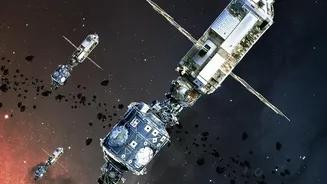
effects, and front projection techniques, Kubrick created a vision of the future so convincing it still holds up today. The iconic match cut from a prehistoric bone to an orbiting satellite is a legendary piece of editing, but it's the silent, balletic sequences of spacecraft docking to the sound of 'The Blue Danube' that truly define its big-screen power. Every shot is composed with architectural precision, designed to fill the viewer with a sense of wonder and cosmic dread. Seeing the Discovery One glide past Jupiter on a massive screen is less like watching a movie and more like witnessing a celestial event.
Gravity (2013)
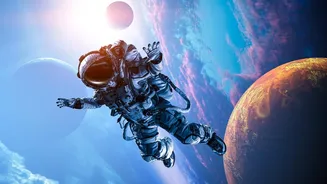
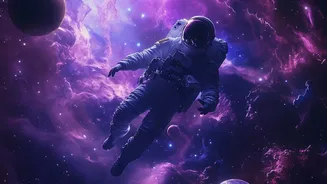
Alfonso Cuarón’s survival thriller is a masterclass in tension, largely thanks to its revolutionary visual approach. The film famously opens with an extended, uncut sequence that immerses you completely in the terrifying reality of a spacewalk gone wrong. Cinematographer Emmanuel Lubezki and his team developed new technology to simulate the physics of zero gravity with terrifying accuracy. The camera floats seamlessly from a wide-shot of the Earth to the claustrophobic confines of a single helmet, making the vast, silent emptiness of space a character in itself. On a large screen, the sense of scale is breathtaking and overwhelming. When debris hurtles towards the screen, you feel the instinct to duck. It’s a visceral, heart-pounding experience that brilliantly uses visual storytelling to convey both the beauty and the unforgiving danger of being untethered from the world.
Interstellar (2014)
Christopher Nolan aimed for both spectacle and scientific accuracy, creating a journey that is as intellectually stimulating as it is visually staggering. Working with theoretical physicist Kip Thorne, the visual effects team created one of the most realistic depictions of a black hole (Gargantua) and a wormhole ever put to film. This wasn't just artist's interpretation; the visuals were generated from real scientific equations. But the film's genius lies in grounding these cosmic wonders in human emotion. The trip through the wormhole, the sight of a planet plagued by 4,000-foot-tall waves, and the haunting beauty of a world frozen in time are sequences designed to dwarf the audience. Nolan’s preference for in-camera effects and shooting on IMAX film makes this a quintessential theatre experience, where the sheer size of the screen is necessary to comprehend the ambition of the voyage.
The Martian (2015)
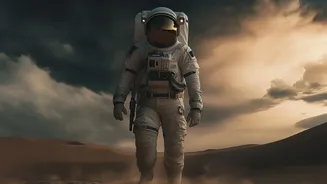
While many space epics focus on the fantastical, Ridley Scott’s 'The Martian' finds its spectacle in realism. The film's beauty lies in its grounded, science-based approach to survival. Extensive consultation with NASA resulted in designs for the Hermes spacecraft and Mars habitats that feel authentic and functional. The visual effects team painstakingly turned locations in Jordan into the vast, ochre landscapes of Mars, adding mountains and a signature red tint to create a convincing alien world. What makes it a big-screen must-see is the sheer scale of the Martian environment. The wide, sweeping shots of Mark Watney's rover dwarfed by colossal craters and endless plains truly sell his isolation. It’s a film that uses its visuals not for fantasy, but to make the incredible feat of human ingenuity and survival feel tangible and awe-inspiring.
Dune (2021 & 2024)
Though largely set on a desert planet, Denis Villeneuve’s 'Dune' films are fundamentally about scale, and nothing showcases this better than their depiction of space travel and colossal machinery. The sheer size of the Guild Heighliners folding space, the brutalist architecture of the ships landing on Arrakis, and the iconic sandworm sequences are crafted for the biggest canvas imaginable. The scene in 'Dune: Part Two' where Paul Atreides rides a sandworm for the first time is a monumental piece of cinema, filmed over months with a dedicated 'Worm Unit' to capture its power and immensity using natural light. Cinematographer Greig Fraser’s work makes the sand feel like an ocean and the worms like gods. These are not just visual effects; they are world-building on an epic scale, designed to make the audience feel small in the face of a vast, mysterious, and dangerous universe.