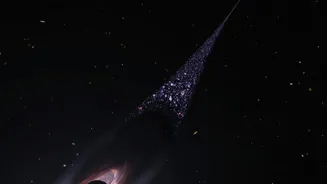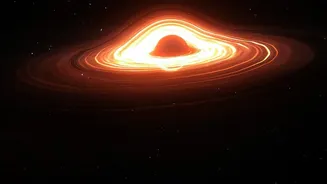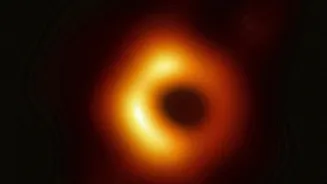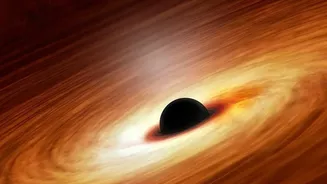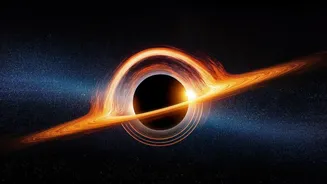




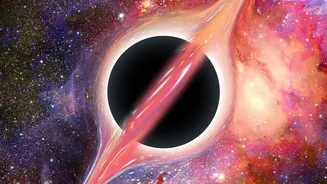
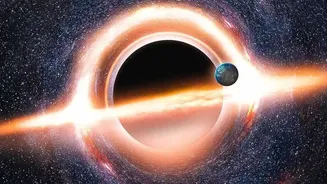
Black holes are the universe's ultimate points of no return, famous for merging and growing ever larger. But what if they could do the opposite? New theoretical research is challenging long-held beliefs by exploring how they might split.
The Universe's One-Way Street
For decades, our
understanding of black holes has been governed by a simple rule: they can merge, but they can't divide. This comes from some of the most fundamental principles in physics, including Albert Einstein's theory of general relativity and the laws of thermodynamics. One key concept is entropy, a measure of disorder in a system. Physicist Stephen Hawking proposed an area theorem in 1971, which states that the total surface area of a black hole's event horizon—the boundary from which nothing can escape—can never decrease. Since a black hole's entropy is tied to this surface area, and because splitting one large black hole into two smaller ones would almost certainly decrease the total area, the process has long been considered thermodynamically impossible. It would be like an egg spontaneously unscrambling itself—a violation of the natural tendency toward disorder. This principle has been a cornerstone of black hole physics, reinforcing their image as cosmic behemoths that only grow.
A High-Speed Loophole
However, new theoretical research published in the journal 'Physical Review D' suggests a fascinating loophole. A team of physicists calculated that while a stationary black hole is bound by the no-split rule, the situation changes dramatically for a black hole spinning at extreme speeds. The energy associated with this rapid rotation could, in theory, provide a way to bypass the normal thermodynamic barrier. The calculations show that a black hole rotating at or near its maximum possible speed might be able to divide without violating these physical laws. This doesn't mean it's easy. For a split to successfully occur, the two newly formed black holes must be able to separate and move apart, rather than immediately being pulled back together by their immense gravity to merge once more. This requirement makes the conditions for a split incredibly narrow, limiting the possibility to only the fastest-spinning black holes.
The 'Pair-of-Pants' Split
So what would this cosmic division actually look like? The researchers describe the process with a surprisingly relatable analogy: a 'pair-of-pants topology'. In their models, the event horizon of the original black hole wouldn't just crack in half. Instead, it would deform and stretch through spacetime, creating a shape resembling a pair of trousers, with a single black hole going in the 'waist' and two smaller black holes emerging from the 'legs'. This visual helps conceptualise how a single connected object can evolve into two separate ones. The research also found that a split is more likely if the resulting black holes are of unequal size, with one being considerably smaller than its twin. This theoretical framework provides the first mathematical description of how such a previously forbidden event could unfold.
From Theory to Observation
It's important to remember that this is all theoretical; no black hole has ever been observed splitting. The study explores what is possible within the laws of physics, not what is common. The probability of such an event happening depends on aspects of gravity that go beyond Einstein's established theories, which scientists are still working to quantify. However, the research does propose a potential way to spot this phenomenon indirectly. The team suggests that smaller, primordial black holes, which are hypothetical black holes formed soon after the Big Bang, might be more prone to splitting than the larger ones we typically observe. If one were to split, the event could release high_energy light that might be detectable by gamma_ray telescopes, offering a potential, though challenging, observational signature to hunt for.