

A Planet of Endless Seasons
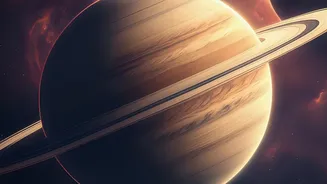
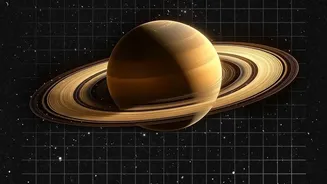
Just like Earth, Saturn is tilted on its axis, which means it experiences seasons. But unlike our brisk, three-month cycles, a season on Saturn lasts for more than seven Earth years. This slow, grand progression from summer to autumn provides a unique
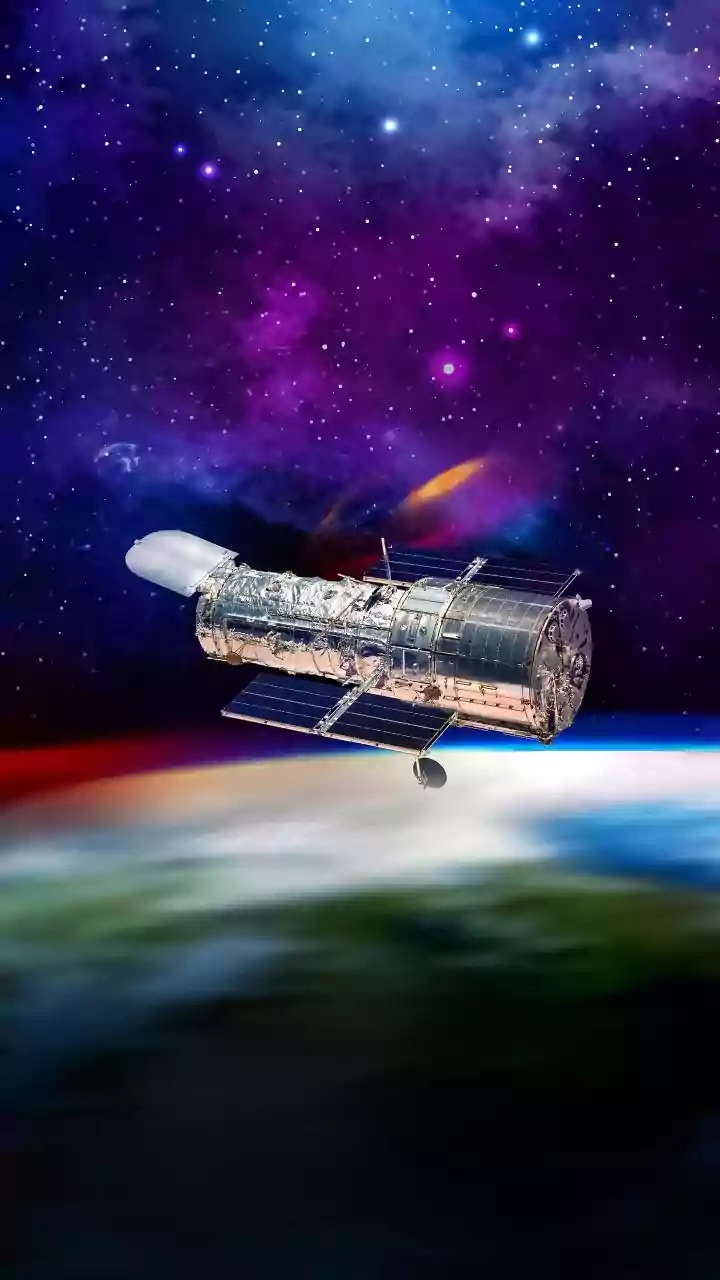
natural laboratory for planetary scientists. Because a single Saturnian year takes about 29 Earth years to complete, long-term observation is the only way to track these colossal changes. This is where the Hubble Space Telescope’s Outer Planet Atmospheres Legacy (OPAL) program comes in. By dedicating time each year to photograph our solar system's outer giants, Hubble has built an invaluable visual record of their atmospheric evolution.
Hubble's Watchful Eye
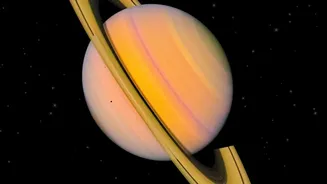
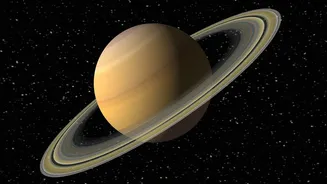
The latest images, captured in August 2024, continue this crucial work. They provide a detailed snapshot of Saturn as its northern hemisphere transitions from a long summer towards its 2025 equinox. For over a decade, the OPAL program has been tracking the subtle and sometimes dramatic shifts in the planet's cloud bands, colours, and storm activity. These yearly check-ins allow scientists to move beyond a single snapshot and build a comprehensive story of how a gas giant's atmosphere works over time. The recent 2024 observations are particularly exciting as they have been complemented by views from the James Webb Space Telescope (JWST), allowing for an even more complete picture.
Revealing Subtle Colour Shifts
One of the most fascinating findings from Hubble’s long-term monitoring is the subtle change in the colours of Saturn's atmospheric bands. Observations have shown that from 2018 to 2020, the planet's equator brightened by 5 to 10 percent. Scientists believe these shifts could be driven by the changing angle of sunlight as the seasons progress. This increased solar energy might alter the atmospheric circulation or change the composition of photochemical hazes, leading to visible colour variations. The year-to-year changes are slight, but they signal the larger seasonal transformations that are underway, offering clues about the chemistry and dynamics deep within the planet's clouds.
A Three-Dimensional Atmosphere
While Hubble provides a stunning view of Saturn in visible light—what our own eyes would see—pairing its observations with the infrared capabilities of the JWST has been revolutionary. This combined approach allows scientists to effectively 'slice' through Saturn’s atmosphere at different altitudes, like peeling back the layers of an onion. Hubble reveals the soft, banded patterns on the surface, while Webb peers deeper, sensing chemicals and clouds at various depths. This collaboration has highlighted features like the 'ribbon wave', a meandering jet stream, and the lingering remnants of the 'Great Springtime Storm' from over a decade ago. For the first time, scientists can study Saturn’s atmosphere as a complete three-dimensional system.
A Farewell to the Hexagon?
Faintly visible in the new images is one of Saturn's most iconic and mysterious features: the six-sided jet stream at its north pole, known simply as 'the hexagon'. First discovered in 1981, this persistent weather pattern has remained a source of fascination. However, as Saturn's northern hemisphere tilts away from the sun and enters its long winter, the hexagon will be plunged into darkness. Scientists believe these 2024 images may be among the last high-resolution views we get of this strange structure until the 2040s, when spring returns to the planet's north pole.