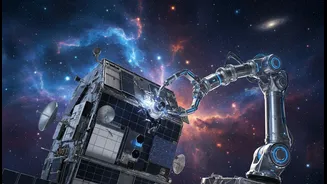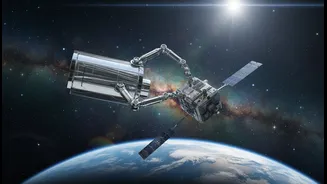






What is Space Servicing Anyway?
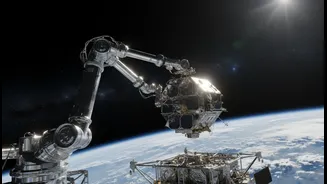
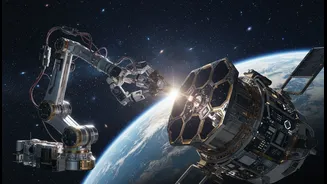
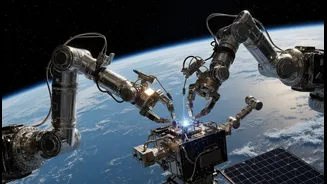
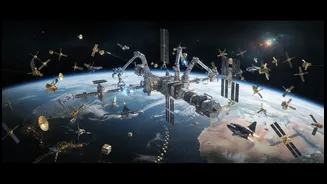
Think of it as roadside assistance for the space age. On-orbit servicing, also called in-space servicing and manufacturing (ISAM), covers a range of activities designed to maintain, repair, upgrade, refuel, and even relocate satellites directly in their
orbits. Instead of launching a costly replacement for a satellite that's merely out of gas or has a fixable glitch, a servicing vehicle can rendezvous with it, perform the necessary task, and significantly extend its operational life. This not only saves money but is also crucial for managing the growing problem of space debris in Earth's increasingly crowded orbits.
From Bit Part to Leading Role
The concept isn't new, but the technology and economics are finally catching up to the ambition. For years, the high cost and complexity of rendezvous and docking manoeuvres made servicing missions impractical. However, a perfect storm of factors has pushed it into the spotlight. The rise of private space companies has drastically lowered launch costs, while the proliferation of satellite mega-constellations has created both a huge market for servicing and a pressing need to deorbit old satellites to avoid collisions. The global market for on-orbit servicing is now projected to grow from a few billion dollars in 2025 to over $12 billion by 2035. Governments and commercial operators now see it not as a luxury, but as a strategic necessity for a sustainable space economy.
The Stars of the Show
Several key players are proving the concept is not just possible, but profitable. Northrop Grumman's SpaceLogistics division has been a pioneer with its Mission Extension Vehicle (MEV), which has already performed successful life-extension missions by docking with and taking over propulsion for commercial satellites. The company is now developing a more advanced Mission Robotic Vehicle (MRV) slated for launch in 2026, which will install smaller 'jet packs' on aging satellites. Meanwhile, companies like Japan's Astroscale are focused on the other end of the lifecycle: debris removal. Its recent ADRAS-J mission successfully inspected a piece of space junk, paving the way for future removal missions. Just this month, in early July 2026, a robotic servicing spacecraft from Katalyst Space Technologies launched on a mission to rescue NASA's ageing Swift observatory by boosting it into a higher orbit.
A New Plot for the Space Economy
The implications are transformative. For satellite operators, life extension means maximizing the return on billion-dollar assets. It changes the entire financial model from a fixed lifespan to a potentially indefinite one, where satellites are upgradeable and maintainable infrastructure. This could lead to more robust and resilient satellite networks for communications, Earth observation, and navigation. Furthermore, the ability to assemble large structures in orbit, which is part of the long-term vision, could enable missions and technologies—like massive space telescopes or interplanetary staging posts—that are too large to launch from Earth in one piece. It's a fundamental shift from disposable space hardware to a circular, sustainable, and more dynamic space ecosystem.
India's Role in this Evolving Story
India is rapidly scripting its own entry into this domain. The Indian Space Research Organisation (ISRO) has already demonstrated critical capabilities with its SPADEX (Space Docking Experiment) mission, which successfully performed rendezvous and docking manoeuvres in 2025. This technology is a vital building block for future satellite servicing, as well as for the planned Bharatiya Antariksh Station (Indian Space Station). Beyond ISRO, a vibrant ecosystem of Indian startups is emerging. Companies like Aule Space, OrbitAID, and InspeCity are developing technologies for life extension, satellite refueling, and robotic operations. With its low-cost engineering base and strong government support through initiatives like IN-SPACe, India is well-positioned to become a globally competitive player, potentially reshaping the economics of on-orbit servicing.