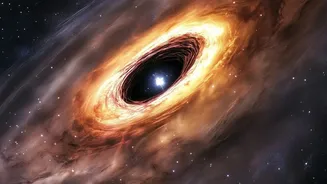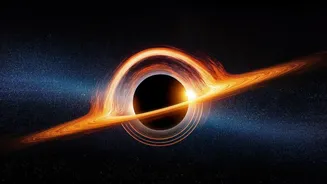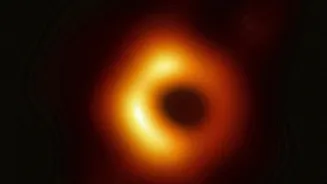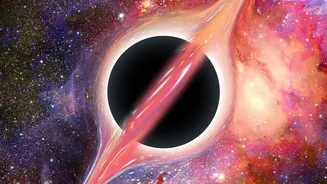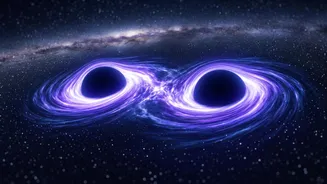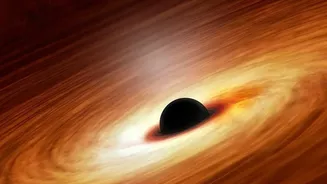








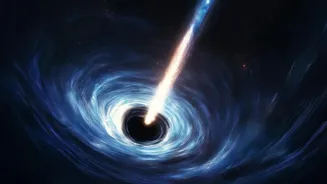

In the cosmic rulebook, black holes are famous for merging, not splitting. They are the universe's ultimate titans, growing larger by consuming matter and combining with each other. But what if one could tear itself in two?
The Cosmic Law of Mergers
For decades, our understanding
of black holes, governed by Einstein's theory of general relativity, has been clear on one point: they grow. When two black holes collide, the cataclysmic event ripples the fabric of spacetime with gravitational waves, leaving behind a single, more massive black hole. This one-way street is underpinned by fundamental laws of physics, particularly thermodynamics. A key concept is entropy, a measure of disorder. According to Stephen Hawking's area theorem, the surface area of a black hole's event horizon—its point of no return—can never decrease. Since a black hole's entropy is proportional to this area, splitting a single black hole into two smaller ones would ordinarily result in a lower total entropy, which is a process that is thermodynamically forbidden. Think of it like trying to unscramble an egg; the universe strongly favours moving toward more disorder, not less.
A Loophole In The Law
A recent theoretical study, published in the journal Physical Review D, has explored a potential loophole in this cosmic law. An international team of physicists investigated the specific conditions under which a black hole might be able to split. Their calculations suggest that one crucial factor could change everything: extreme rotation. The researchers found that if a black hole spins at or very near its maximum possible speed, the usual thermodynamic rules can be bent. An extremely fast-spinning black hole has a smaller surface area (and thus, lower entropy) to begin with compared to a non-spinning one of the same mass. This creates a scenario where it could theoretically split into two smaller black holes whose combined surface area—and therefore entropy—is greater than the original, satisfying the laws of thermodynamics.
The 'Pair-of-Pants' Problem
The geometry of such a split is bizarre to contemplate. The study's title, 'When Black Holes Admit Pair-of-pants Topologies', describes what the event horizon would look like over time: a single tube of spacetime branching into two separate 'legs'. However, even if the thermodynamics check out, there's another major hurdle. The two newly formed black holes must be able to fly apart fast enough to escape each other's immense gravity. If they don't, they would immediately fall back together and merge, negating the split. According to the researchers, this requirement makes the window for a successful split incredibly narrow, closing it for all but those black holes rotating at the absolute theoretical limit.
Why This Hypothesis Matters
For now, a splitting black hole remains a purely theoretical and highly speculative idea. There is no observational evidence that this has ever happened. However, exploring these extreme possibilities is crucial for pushing the boundaries of physics. It forces scientists to question the limits of Einstein's theory of general relativity and consider what might lie beyond it. The researchers suggest that such a phenomenon would be more likely for smaller, primordial black holes that may have formed in the early universe. They even propose a way to look for indirect evidence. If tiny black hole fragments are produced, their eventual evaporation could release bursts of gamma rays, which telescopes like NASA's Fermi-LAT could potentially detect.