




First, A Quick Name Correction
Before we dive in, let’s clear up the name. The object that caused all the excitement was officially designated C/2019 Y4 (ATLAS). The 'ATLAS' part comes from the observatory that found it: the Asteroid Terrestrial-impact Last Alert System in Hawaii.
The headline's “3I” is likely a misunderstanding. In astronomy, an “I” in a name stands for 'interstellar,' meaning it came from outside our solar system. We've only confirmed two such visitors so far: 1I/'Oumuamua and 2I/Borisov. Comet ATLAS was not the third. It was a homegrown object, born in the icy fringes of our own solar system, in a vast region called the Oort Cloud.
The Promise of a Once-in-a-Generation Show
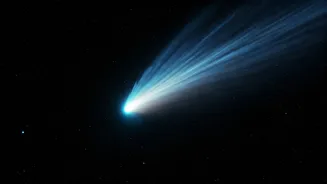
So why all the hype? When ATLAS was discovered in late 2019, it was just a faint smudge. But by early 2020, it was brightening at an astonishing rate. Astronomers were buzzing. Projections suggested that by the time it made its closest approach to the sun in May, it could become brilliantly bright, potentially visible to the naked eye even from city suburbs. The world, stuck at home in the early days of the COVID-19 pandemic, was desperate for a distraction. A spectacular 'great comet'—the kind that only appears once or twice a decade—seemed like the perfect cosmic spectacle to lift everyone's spirits.
Why the 'Alien' Speculation?
Whenever an object in space does something unexpected, the 'alien' theory is never far behind. With ATLAS, its rapid brightening seemed unusual. For those looking for extraterrestrial signs, any anomaly can be interpreted as evidence of technology—a spacecraft powering up its engines, for example. This was the same kind of speculation that surrounded 'Oumuamua, whose strange shape and movement led some, including Harvard astronomer Avi Loeb, to propose it could be an alien probe. However, for ATLAS, there was no scientific data to support this. Its behaviour, while exciting, was still within the realm of known cometary physics. The alien connection was pure speculation, fueled by a human desire to find meaning and intelligence in the cosmos.
A Spectacular Disintegration
The great show we were promised never happened. Instead, we got a different kind of spectacle. In late March and early April 2020, just as anticipation was peaking, the comet’s brightness suddenly stalled, then started to fade. Amateur and professional astronomers watched in real-time as the comet’s solid nucleus, its heart of ice and rock, began to break apart. The Hubble Space Telescope was pointed at the dying comet and delivered breathtaking images. Instead of one solid point of light, Hubble saw a cascade of smaller, icy fragments, each with its own tail, like a celestial string of pearls slowly drifting apart. The comet couldn’t handle the increasing heat from the sun. The great celestial hope had crumbled under pressure.
The Science of a Comet's Death
While sky-gazers were disappointed, scientists were thrilled. Seeing a comet disintegrate up close is a rare and valuable opportunity. It's like getting to look under the hood of a car you've only ever seen from the outside. The way ATLAS broke apart provided clues about its structure and composition. Comets are thought to be primordial leftovers from the formation of the solar system, about 4.6 billion years ago. They are fragile, often described as 'dirty snowballs' or 'icy dirtballs.' Watching one fall apart helps scientists understand the 'glue' that holds these ancient bodies together and the processes that shaped our solar system in its infancy. In its death, Comet ATLAS gave us a much better gift than a pretty light show: it gave us priceless data.