


In the cosmic rulebook, black holes are known for merging, not splitting. They are the universe's ultimate points of no return. But what if that rule could be broken? New research is exploring the bizarre conditions under which this might happen.
The Unbreakable Law of Black Holes
For decades,
our understanding of black holes has been governed by a fundamental principle: they can collide and merge, but they cannot divide. This idea is rooted in the second law of thermodynamics, which states that the total entropy, or disorder, of an isolated system can never decrease. For a black hole, entropy is proportional to the surface area of its event horizon—the boundary beyond which nothing can escape. If a standard, non-rotating black hole were to split into two smaller ones, the combined surface area of the new black holes would be less than that of the original. This decrease in entropy makes the process thermodynamically forbidden, much like an egg is unlikely to unscramble itself.
A Loophole Involving Extreme Spin
A new theoretical study, published in the journal Physical Review D, proposes a fascinating loophole. A team of physicists investigated what might happen if a black hole was spinning at an incredibly high speed. A rapidly rotating black hole has less entropy than a non-spinning one of the same mass. This crucial difference opens up a narrow window of possibility. The researchers calculated that if a black hole spins at or near its maximum possible rate, it might be able to split without violating the law of entropy. The rotational energy of the parent black hole could be converted into the orbital momentum of the two new fragments, allowing the split to be thermodynamically favourable.
The 'Pair-of-Pants' Problem
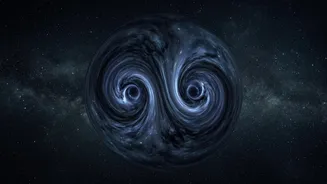
Even if the thermodynamics work out, there is another major hurdle: gravity. For a split to be successful, the two new black holes must have enough energy to fly apart and escape each other's immense gravitational pull. Otherwise, they would immediately fall back and merge into one again. This requirement makes a split extremely unlikely for most black holes. The researchers found that only those spinning at their absolute physical limit might have a chance. The shape the event horizon would make during such a split—one tube of spacetime branching into two 'legs'—led the authors to give their paper the unusual title, 'When Black Holes Admit Pair-of-pants Topologies'.
Beyond Einstein and Into Other Dimensions
The probability of this phenomenon actually occurring may depend on physics beyond Einstein's theory of general relativity. Co-author Francesco Sannino notes that quantifying the exact likelihood requires a deeper understanding of gravity at the quantum scale. The team also explored more exotic scenarios, such as theories involving extra dimensions of space. In some of these alternate models, black-hole-like objects can become unstable and break apart, particularly if the resulting fragments are of very different sizes. The researchers believe that smaller, primordial black holes—hypothetical objects formed in the early universe—would be more likely candidates for splitting than the massive astrophysical black holes we commonly observe.