


A World in the Making
Imagine peering back in time, not by years or centuries, but by billions of years, to witness the birth of a planet. That is precisely what astronomers have achieved. Recent observations have focused on systems like Beta Pictoris, a young star just 63
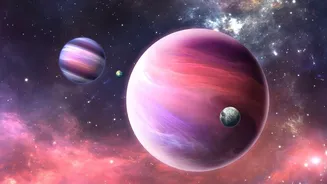
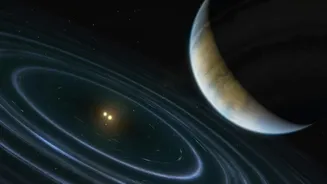
light-years from Earth. This system is a mere 23 million years old—a toddler in cosmic terms compared to our 4.6-billion-year-old solar system. Within its swirling disk of gas and dust, scientists have been able to directly image planets in the process of formation. One such recent discovery in this famous system, Beta Pictoris d, offers a fascinating look at a gas giant coalescing from the primordial materials left over from its star's birth. This isn't a static photograph but a dynamic scene, where gravitational forces are actively shaping a new world.
The Power of New Eyes
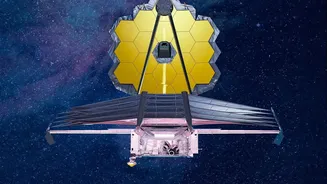
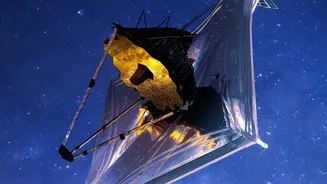
This breakthrough was made possible by the unprecedented power of the James Webb Space Telescope (JWST). While astronomers have known about young planetary systems for years, the ability to resolve fine details has been limited. JWST, with its advanced infrared instruments, can pierce through the dense clouds of dust that obscure these nascent worlds. In the case of Beta Pictoris d, astronomers didn't just spot a faint point of light; they used a technique that detected the planet by mapping the unique chemical fingerprint of its atmosphere. This method allows scientists to not only find a planet but to begin to understand its composition from the moment of its birth. By analysing the light that passes through the planet-forming disk, researchers can identify elements like neon and argon, revealing how the gas and dust that form planets are behaving and dispersing over time.
A Glimpse into Our Past
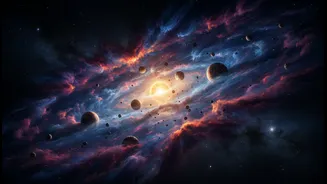
Studying a young system like Beta Pictoris is akin to finding a fossil that perfectly captures a stage of our own evolution. The prevailing theory of solar system formation, the nebular hypothesis, suggests that our Sun and planets formed from a collapsing cloud of gas and dust. The material in the center ignited to form the Sun, while the remaining matter flattened into a protoplanetary disk. Within this disk, tiny particles of dust began to stick together, a process called accretion, gradually building up to form planetesimals, and eventually, the planets we see today. Observing Beta Pictoris allows scientists to see this process not as a theory on a whiteboard, but as a live event. The chaotic interactions, the clearing of orbital paths, and the accumulation of mass are all happening in real-time, providing invaluable data to refine our models of how our own planetary home came to be.
The Building Blocks of Worlds
The insights gained from these young systems extend beyond just the large gas giants. The location and composition of these newly formed planets provide clues about the conditions that might allow for smaller, rocky worlds like Earth to form. The gravitational influence of these giant planets can be profound, shepherding asteroids and comets and potentially delivering water and organic materials to inner planets. In some systems, scientists are observing the very first step: the condensation of hot minerals into the solid specks that will eventually become the building blocks of terrestrial planets. By seeing where these different materials exist in a young disk—gases, ices, and rock—scientists can better understand why planets like Jupiter are gas giants in the outer solar system, while planets like Earth are rocky worlds closer to the Sun. Each new observation helps complete the complex puzzle of planetary architecture.