

Earth's Hellish Twin
For centuries, Venus was imagined as a potential paradise, Earth's sister planet shrouded in mystery. The reality is far more brutal. The surface temperature averages a staggering 467 degrees Celsius, and the atmospheric pressure is over 90 times that
of Earth at sea level. This is an environment so extreme that previous landers, like the Soviet Union's Venera probes, survived for mere minutes before being cooked and crushed. The atmosphere itself is a toxic cocktail, composed mostly of carbon dioxide with thick, opaque clouds of sulfuric acid that make observing the surface from orbit with conventional cameras impossible. It's into this cauldron that NASA is preparing to send its next-generation explorer.
Enter the DAVINCI Mission
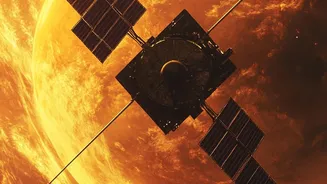
The mission at the heart of this challenge is NASA's DAVINCI (Deep Atmosphere Venus Investigation of Noble gases, Chemistry, and Imaging). Scheduled for the early 2030s, its centrepiece is a one-meter-wide descent probe designed to do what no mission has done in decades: plunge through the Venusian atmosphere and analyze it layer by layer. The probe is a marvel of engineering, a spherical fortress designed to protect its sensitive instruments from the planet's fury. Its primary goal is to taste and 'sniff' the atmospheric gases to understand how Venus, a world that may have once hosted oceans, evolved into the runaway greenhouse it is today. But DAVINCI will also see, and that's where the real drama begins.
A One-Hour Plunge into Chaos
The probe's descent is a frantic, 60-minute journey to the surface. The term "rapidly evolving descent" refers to the constantly changing conditions the probe will experience. It will be released from its carrier spacecraft, deploy a parachute to slow its initial fall through the incredibly thick upper atmosphere, and then continue its descent. In this single hour, it will transition from the upper cloud decks to the crushing pressure and searing heat near the ground. Every instrument, especially the camera, has one chance to get it right. There are no do-overs. The data must be collected and transmitted back to the orbiter before the probe is inevitably silenced by the planet's extreme environment.
A Camera Built for the Inferno
At the bottom of the DAVINCI probe is the Venus Descent Imager (VenDI), a specialized camera system with a monumental task. To peer through the thick haze, it will capture images in the near-infrared spectrum. The biggest physical challenge is the window. Normal glass would crack instantly under the immense pressure. Instead, the VenDI camera will be protected by a window made from lab-grown sapphire, an incredibly durable material that can withstand the environment while remaining optically pure. As the probe falls, the camera will take hundreds of images of the terrain below. The goal is to stitch these images together to create 3D topographic maps of a mountainous region called Alpha Regio, providing a level of detail never seen before. To ensure this technology works, teams have been rigorously testing prototypes by flying them under helicopters in Utah, simulating the descent and data capture process.
The Scientific Prize: A New View of Venus
So why risk so much for these images? Because they could rewrite our understanding of Venus. Scientists will use the detailed 3D maps to study the geology of Alpha Regio, a rugged highland area thought to be one of the oldest surfaces on the planet. These are features that may be analogous to Earth's continents. By analyzing the shapes, structures, and even the composition of the rocks from these images, scientists hope to answer a fundamental question: did Venus ever have continents and oceans? The images from VenDI will provide crucial context for the atmospheric data, linking the processes happening in the sky to the geology on the ground. It will be our first high-fidelity look at an ancient landscape on another world in more than 40 years, potentially unlocking secrets about why Earth's twin took such a dramatically different path.