

What Exactly Are You Looking For?
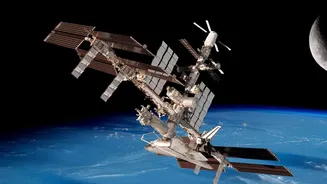
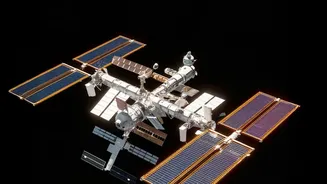
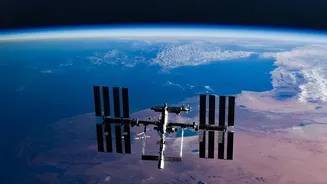
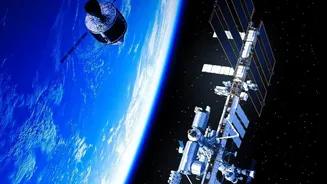
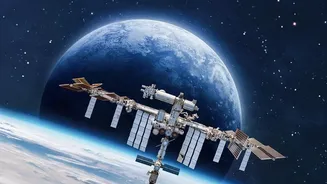
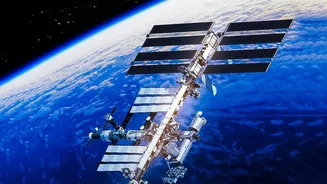
Forget what you've seen in movies. From the ground, the ISS doesn't look like a detailed spacecraft. Instead, it appears as a very bright, steady, white point of light, similar to a brilliant star or planet. The key difference is its speed. While stars
and planets maintain fixed positions relative to each other, the ISS moves purposefully across the sky. It travels much faster than an aeroplane but doesn't have blinking lights. It appears, arcs overhead for a few minutes, and then fades as it moves into Earth's shadow or over the horizon. The entire sighting is completely silent and can be seen with the naked eye, no telescope required.
Finding Sighting Times for Your City
The ISS is only visible at dawn or dusk. This is the perfect time when the sky is dark enough to see the station, but the sun is still low enough to illuminate it as it passes about 400 kilometres overhead. To find precise timings for your location, the best resource is NASA's own 'Spot The Station' website. You can select India from the country list and then choose a major city near you. The platform provides a list of upcoming viewing opportunities, telling you the exact date and time the sighting will start, how long it will last, its maximum height, and the direction in which it will appear and disappear. Remember that the viewing windows are specific, so checking the schedule is essential for a successful sighting.
Understanding the Sighting Data
When you get the sighting information, you'll see a few key terms. 'Max Height' is one of the most important. Measured in degrees, it tells you how high the station will be from the horizon at its peak. A 90-degree pass is directly overhead, while a 10-degree pass will be very low on the horizon. Higher passes are brighter and easier to see. 'Appears' and 'Disappears' will give you compass directions (like WSW for West-South-West or NE for North-East) telling you where to look for the station to enter and exit your field of view. 'Visible' tells you the duration of the pass, which is typically between three and seven minutes.
Essential Apps for ISS Tracking
While the NASA website is excellent for planning, mobile apps can provide real-time guidance. The official 'SpotTheStation' app (for iOS and Android) is a great starting point, offering alerts and live tracking. Another popular choice is 'ISS Detector', which is highly praised for its user-friendly interface and ability to use your phone's camera and compass to show you exactly where to point it in the sky. Other reliable options include Heavens-Above and Satellite Tracker, which not only track the ISS but other satellites as well. Many of these apps will send you a notification just before a visible pass is about to happen at your location, so you don't miss it.
Tips for the Best Viewing Experience
To make the most of your sighting opportunity, a little preparation goes a long way. First, find a spot with a clear view of the sky, away from tall buildings and trees that might obstruct your view, especially near the horizon where the ISS will appear and disappear. Give your eyes about 15 minutes to adjust to the darkness; this will make it much easier to spot the station's light. Be ready a few minutes before the scheduled time and know your directions (North, South, East, West). Finally, be patient. The ISS moves quickly, but the experience of watching this outpost of humanity, travelling at over 27,000 km/h, is a truly special moment.