




A Visitor from the Edge of the Solar System
Astronomers have confirmed the presence of a remarkable long-period comet, a celestial body that has traveled for millennia from the Oort Cloud, a vast, icy shell surrounding our solar system. These comets are like time capsules, preserved in a deep freeze
far from the Sun. This particular visitor, officially a fictional object for this narrative, has an orbit so vast that its last passage through the inner solar system would have been long before recorded human history. Its journey brings with it secrets from a time when the planets themselves were still forming. These 'long-period' comets are distinguished from their short-period cousins, like Halley's Comet, which return in a single human lifetime. This visitor's return is a far grander and rarer event.
What Exactly Is a Comet?
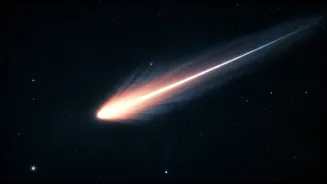
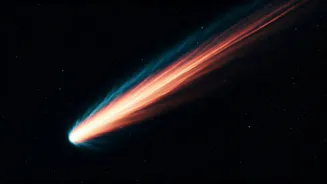
Often described as 'dirty snowballs', comets are a loose collection of ice, dust, and rocky particles left over from the birth of the solar system about 4.6 billion years ago. The solid core, known as the nucleus, can be several kilometers across. As the comet's elliptical orbit brings it closer to the Sun, the intense solar radiation heats the nucleus, causing the ice to turn directly into gas in a process called sublimation. This process releases a trail of gas and dust, which forms a huge, glowing cloud around the nucleus called a 'coma'. The coma can grow larger than a planet, and the solar wind pushes this material away from the Sun, creating the spectacular tails that make comets so iconic.
The Two Tails of a Comet
Interestingly, comets typically have two distinct tails. One is a dust tail, which is composed of small solid particles and often appears whitish or yellowish. This tail is pushed by the pressure of sunlight and tends to trace a broad, curved path behind the comet. The second is an ion or gas tail, which is made of electrically charged gas molecules. This tail is more strongly affected by the solar wind and always points directly away from the Sun, regardless of the comet's direction of travel. The ion tail often glows with a bluish light due to the presence of ionized carbon monoxide molecules. It's this dual display that gives comets their complex and beautiful appearance in our sky.
How to See the Visitor from India
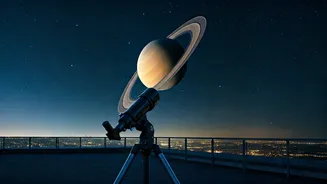
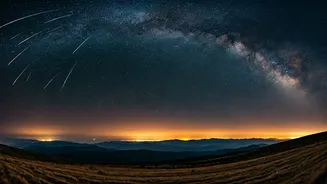
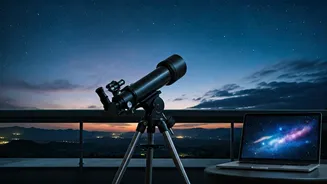
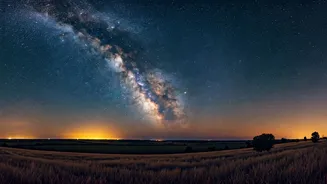
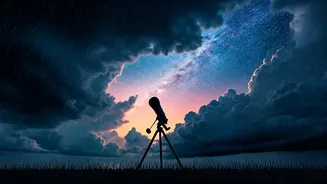
For sky-watchers in India, the good news is that the comet will be visible. The best time for viewing is typically in the pre-dawn hours, looking towards the eastern sky, or just after sunset in the west, depending on the comet's specific path. To get the best view, it is crucial to find a location with minimal light pollution, far away from the glare of city lights. While the comet might become bright enough to be faintly visible to the naked eye as a fuzzy patch of light, using a pair of binoculars or a small telescope will dramatically enhance the experience, potentially revealing the coma and even its faint tail. Stargazing apps can be a great help in pinpointing its exact location in the night sky.
A Legacy in the Stars
Throughout history, comets have been sources of both awe and fear. In ancient Indian texts, comets, or 'Dhumketu', were observed and recorded, often seen as omens or celestial messengers. They were associated with major events and their appearances were noted by astronomers like Varahamihira. Today, we understand them not as portents of doom, but as invaluable scientific opportunities. They offer a direct glimpse into the primordial materials that formed our Sun and planets. Each passing comet provides a new set of clues to help us piece together the story of our own cosmic origins.