




Our Sun's 11-Year Rhythm
The Sun operates on an approximately 11-year cycle, swinging between periods of calm (solar minimum) and intense activity (solar maximum). We are currently in Solar Cycle 25, which has been more active than initially predicted. While scientific models
from organizations like NOAA suggest the absolute peak of this cycle is occurring between late 2024 and mid-2025, the solar maximum is not a single event but a multi-year period of heightened activity. This means that 2026 will still be a year of significant solar events, well within the window of peak conditions that can lead to spectacular auroras. After this active phase, the Sun will slowly quiet down, heading towards the next solar minimum around 2030.
Solar Flares and Coronal Mass Ejections
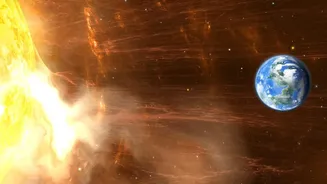
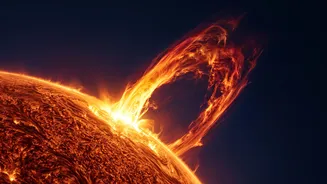
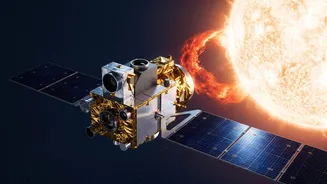
During a solar maximum, the Sun's magnetic field becomes tangled and unstable, leading to an increase in sunspots—dark, complex magnetic regions on the solar surface. These areas are the launching pads for two powerful phenomena: solar flares and coronal mass ejections (CMEs). A solar flare is a tremendous explosion on the Sun's surface, releasing a burst of radiation. A CME is even more significant for auroras; it's a massive eruption that blasts billions of tonnes of plasma and magnetic fields into space at incredible speeds. The more active the Sun, the more frequent and intense these CMEs become, sending waves of charged particles hurtling through the solar system.
The Journey to Earth and Geomagnetic Storms
When a CME is aimed at Earth, it takes about two to three days for the cloud of charged particles to cross space and collide with our planet's magnetosphere—the protective magnetic shield surrounding us. Normally, this shield deflects most of the solar wind. However, a powerful CME can overwhelm these defenses, transferring huge amounts of energy into the magnetosphere and triggering a geomagnetic storm. These storms are graded on a scale, and the most powerful ones (like the G5 event in May 2024) are capable of dramatically distorting our magnetic field, which is the key to creating auroras in unusual places.
Painting the Sky in New Locations
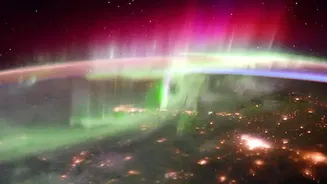
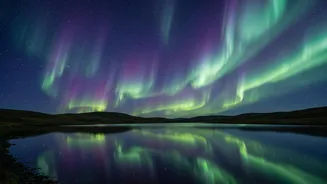
Auroras happen when charged particles from the Sun are funnelled by Earth’s magnetic field lines toward the poles, where they collide with oxygen and nitrogen atoms in the upper atmosphere. These collisions excite the atoms, causing them to glow in vibrant colors like green, pink, and red. Normally, this light show is confined to the 'auroral oval,' a ring around the magnetic poles. But during a strong geomagnetic storm, the auroral oval expands. The intense pressure from the solar wind compresses Earth's magnetic field, allowing the charged particles to penetrate the atmosphere at much lower latitudes than usual. This is how regions in the central United States, Europe, and even northern India can get a rare glimpse of the celestial lights.
Could We See Auroras in India?
While the 2024-2026 solar maximum makes low-latitude auroras more common globally, seeing them from India remains an exceptionally rare event. Sightings are primarily possible from very high-altitude, dark-sky locations in the far north, like Ladakh. In May 2024, during an extreme G5 storm, a faint red glow, a type of aurora-related phenomenon, was indeed captured by cameras at the Hanle observatory in Ladakh. However, this was not the dancing curtain of lights seen in polar regions, and it was invisible from cities due to light pollution. For an aurora to be visible from India, it requires a historically powerful geomagnetic storm. While the current solar cycle provides the best chance in over a decade, sky-watchers in India should manage their expectations and look to the far northern horizon during only the most intense, well-publicized solar events.