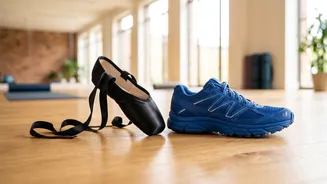






Forward Motion vs. Full-Body Freedom
The most fundamental difference lies in the plane of motion. Running is a master of repetition in the sagittal plane—it's all about forward propulsion. Your muscles, from your quads and hamstrings to your calves and hip flexors, are trained for one primary
goal: to move you forward efficiently. This repetitive motion builds powerful endurance. Dancing, however, is a three-dimensional conversation. It demands movement in every direction: side-to-side (frontal plane) and rotational (transverse plane), in addition to forward and back. This multi-planar movement forces the body to stabilize, pivot, and shift weight in unpredictable ways, engaging a wider array of muscles.
Targeted Power vs. Total-Body Activation
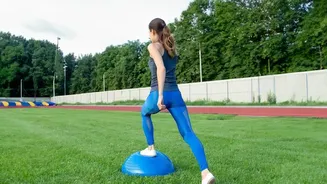
Because running is so linear, it primarily develops the major muscles responsible for that forward drive, like the quadriceps and hamstrings. While a strong core is essential for good running form, the primary work is done by the legs. Dance, by its very nature, is a full-body workout. It calls upon smaller stabilizing muscles in the hips, ankles, and core that running often neglects. Learning choreography or even just grooving to a beat requires precise coordination, balance, and control, which strengthens the connection between your brain and body. This whole-body engagement helps build a more integrated and resilient physique.
The Rhythm of Impact on Your Joints
Impact is a major consideration for long-term joint health. Running is a high-impact activity, meaning with every stride, your body absorbs a significant amount of force. Over time, this repetitive pounding can lead to stress on the knees, hips, and ankles. Dance, while not entirely impact-free (think jumps in ballet or hip-hop), often involves more varied and controlled movements. Many styles, like ballroom, are low-impact, emphasizing smooth, fluid motions that are gentler on the joints. The lateral and rotational movements in dance distribute forces differently, preventing the repetitive strain seen in running.
Mindful Movement and Mental Gains
Both activities offer significant mental health benefits by releasing endorphins, but they stimulate the brain in different ways. The rhythmic, repetitive nature of running can be meditative for many. However, the brain can eventually automate the movement. Dance, on the other hand, constantly challenges the brain. Learning new steps, coordinating with music, and sometimes interacting with a partner requires intense focus, memory, and spatial awareness. Studies have shown that dancing can be superior to repetitive exercise in inducing positive brain plasticity, potentially offering greater protection against age-related cognitive decline.
A Powerful Partnership for Fitness
Instead of viewing it as an 'either/or' choice, the smartest approach may be to see running and dancing as perfect cross-training partners. The multi-directional strength and improved balance from dance can make you a more resilient and efficient runner, reducing injury risk. Dancers often use running to build cardiovascular endurance needed for long performances. By combining the two, you get the linear power and endurance of running alongside the full-body coordination, flexibility, and cognitive engagement of dance. This balanced approach addresses potential weaknesses, prevents plateaus, and creates a more holistic and sustainable fitness routine.