









The Mission: A Fiery Plunge
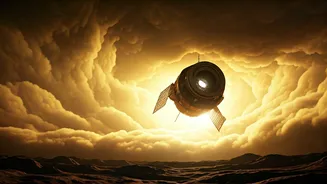
The mission at the center of all this excitement is DAVINCI, which stands for Deep Atmosphere Venus Investigation of Noble gases, Chemistry, and Imaging. [3, 8] Unlike an orbiter that studies a planet from afar, DAVINCI's main event involves a spherical
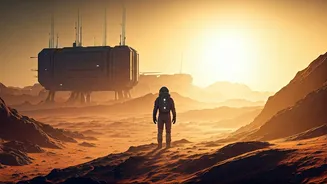
probe, about one meter wide, designed to plunge directly through Venus's crushing atmosphere. [9] This will be the first US-led mission to enter Venus's atmosphere since 1978. [3] The probe will take about an hour to descend, taking thousands of measurements and snapping the first-ever high-resolution images of the surface from below the thick cloud deck. [3, 9] The probe itself isn't required to survive the landing on a surface hot enough to melt lead, but every second of its 63-minute journey will provide a treasure trove of data that scientists have sought for decades. [3, 6, 9]
Venus: Earth's Twisted Sister
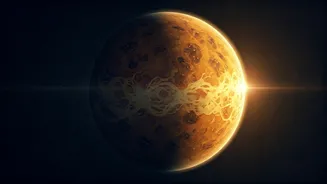
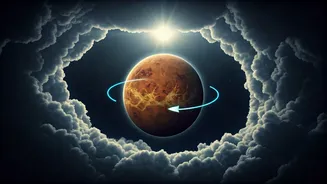
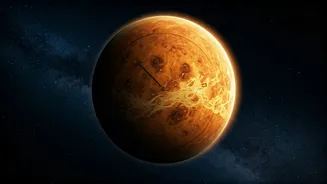
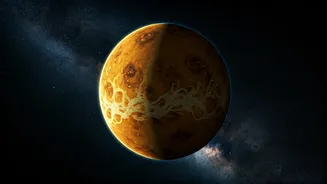
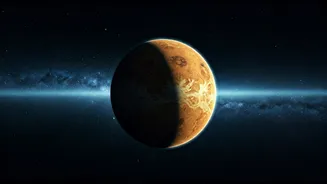
So, why Venus? For a long time, scientists considered it Earth's twin. [9] It's similar in size, mass, and composition, and is our closest planetary neighbor. [9, 16] But the resemblance ends there. Venus is a scorching world with surface pressures over 90 times that of Earth and a toxic atmosphere made mostly of carbon dioxide, with clouds of sulfuric acid. [2, 16] This hostile environment is the result of a runaway greenhouse effect, a climate catastrophe that turned a potentially habitable world into a furnace. [2, 20] Understanding exactly how and why Venus's path diverged so drastically from Earth's is one of the biggest questions in planetary science. It serves as a natural laboratory for studying how climate can transform a planet. [16, 18]
The Science: A Hunt for Ancient Oceans
The primary reason scientists are "buzzing" is DAVINCI's potential to determine if Venus ever had oceans. [1, 5] Models suggest that early in its history, Venus may have had liquid water and temperatures hospitable to life before the greenhouse effect took over. [2] DAVINCI will hunt for clues by measuring the composition of the atmosphere in unprecedented detail. [1, 3] It will analyze noble gases and their isotopes, which act as fingerprints of a planet's formation and evolutionary history. [3, 18] Specifically, it will measure the ratio of hydrogen isotopes, which can help reveal how much water Venus has lost over time. [6] Finding chemical signatures of ancient water would be a monumental discovery, rewriting our understanding of the planet. [11, 12]
A New View of a Mysterious Landscape
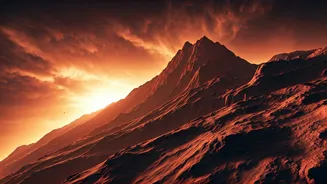
As the probe descends, it will target a unique mountainous region called Alpha Regio. [1, 5] This area is a 'tessera'—a type of strange, wrinkled terrain that scientists believe could be one of the oldest surfaces on Venus, similar to continents on Earth. [4, 5] By imaging this region up close, DAVINCI will provide our first bird's-eye view of these ancient rocks, looking for features that could only have been formed in the presence of water. [11, 19] Previous missions have mapped Venus with radar, but DAVINCI will capture actual images from below the clouds, offering a level of detail never seen before. [19, 20] These images will help create 3D maps that could finally confirm whether these tesserae are ancient continents shaped by long-lost oceans. [19]