





A New Era of Lunar Ambition
The success of Chandrayaan-3 in August 2023 was a moment of immense national pride, making India the first country to soft-land a spacecraft in the lunar south pole region and the fourth nation overall to achieve a soft landing on the Moon. That achievement,
however, was just the beginning. ISRO is now channelling that momentum into Chandrayaan-4, a far more complex and ambitious mission designed to collect samples from the Moon and return them to Earth. If successful, India will join an elite club of nations—currently comprising only the United States, Russia, and China—that have accomplished this difficult feat. This mission is a clear statement of India’s intent to move from merely reaching the Moon to becoming a leader in its scientific exploration and utilization.
What is the Chandrayaan-4 Mission?
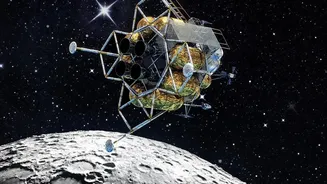
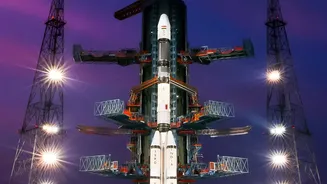
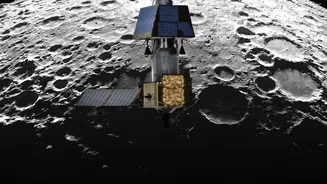
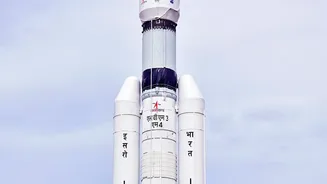
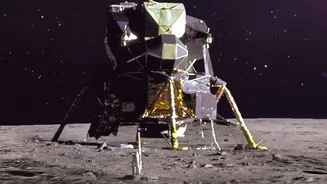
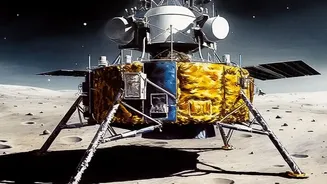
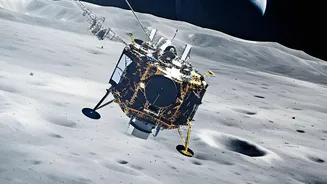
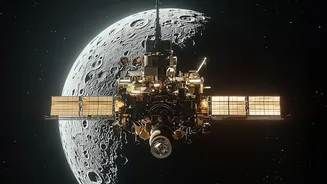
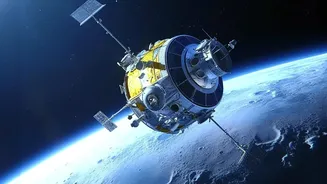
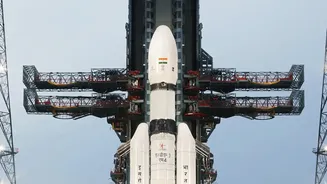
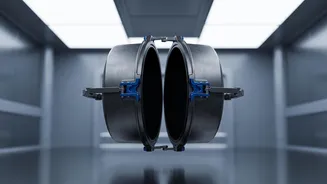
At its core, Chandrayaan-4 is a lunar sample-return mission scheduled for around 2028. The primary objective is to land on the Moon, use a robotic arm and a drill to collect several kilograms of lunar soil (regolith) and subsurface material, and bring them back safely for detailed analysis in labs on Earth. The complexity is staggering, involving five separate modules: a Propulsion Module, a Descender Module (the lander), an Ascender Module (to lift off from the Moon), a Transfer Module, and a Re-entry Module to bring the precious cargo home. Due to the mission's significant weight and complexity, it will require two separate launches using ISRO's heavy-lift LVM3 rocket, with the different components docking in Earth's orbit before heading to the Moon.
The Technological Leap Forward
Chandrayaan-4 represents a massive technological jump for India. The mission will require ISRO to master several new and difficult capabilities. These include launching a vehicle from the surface of another celestial body (the Ascender Module lifting off from the Moon) and performing autonomous rendezvous and docking manoeuvres in deep space—first in Earth orbit to assemble the craft, and then again in lunar orbit to transfer the samples. These are operations that only a few space agencies have ever managed. Furthermore, the mission involves developing a sophisticated robotic arm for sample collection, a drilling mechanism for subsurface access, and a re-entry module capable of surviving the intense heat of returning to Earth's atmosphere. Successfully demonstrating these entirely domestically developed technologies will pave the way for even more ambitious future goals, such as landing an Indian astronaut on the Moon by 2040.
Why Bringing Back Moon Rocks Matters
While in-situ experiments like those done by Chandrayaan-3's rover are valuable, they are limited by the instruments that can be carried to the Moon. Returning physical samples allows scientists to use the full power of advanced laboratories on Earth to conduct far more detailed and varied analyses. These samples, particularly from the largely unexplored south polar region, could hold answers to fundamental questions about the Moon's origin, its geological history, and the presence of water ice. Understanding these aspects is not just for scientific curiosity; water ice, if found in sufficient quantities, could be a critical resource for future long-term lunar bases, providing drinking water, breathable air, and rocket fuel.
Securing India's Place in the Cosmos
A successful Chandrayaan-4 mission would do more than just advance science. It would firmly establish India as a top-tier player in the new global space race. The ability to execute an end-to-end sample return mission is a benchmark of a nation's space-faring prowess, demonstrating a high level of technological maturity and operational confidence. This capability has significant geopolitical implications, enhancing India's status as a credible partner for international collaborations, like the planned LUPEX mission with Japan (Chandrayaan-5), and as a leader in its own right. It solidifies India's reputation for achieving complex space missions cost-effectively, a model that has become ISRO's hallmark. This cements the country's position not as a follower, but as a leader shaping the future of lunar exploration.