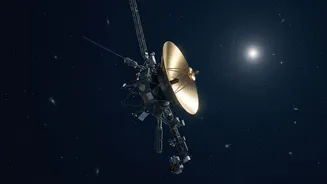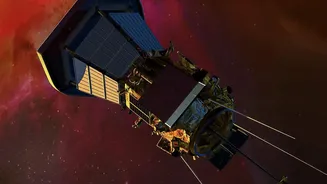

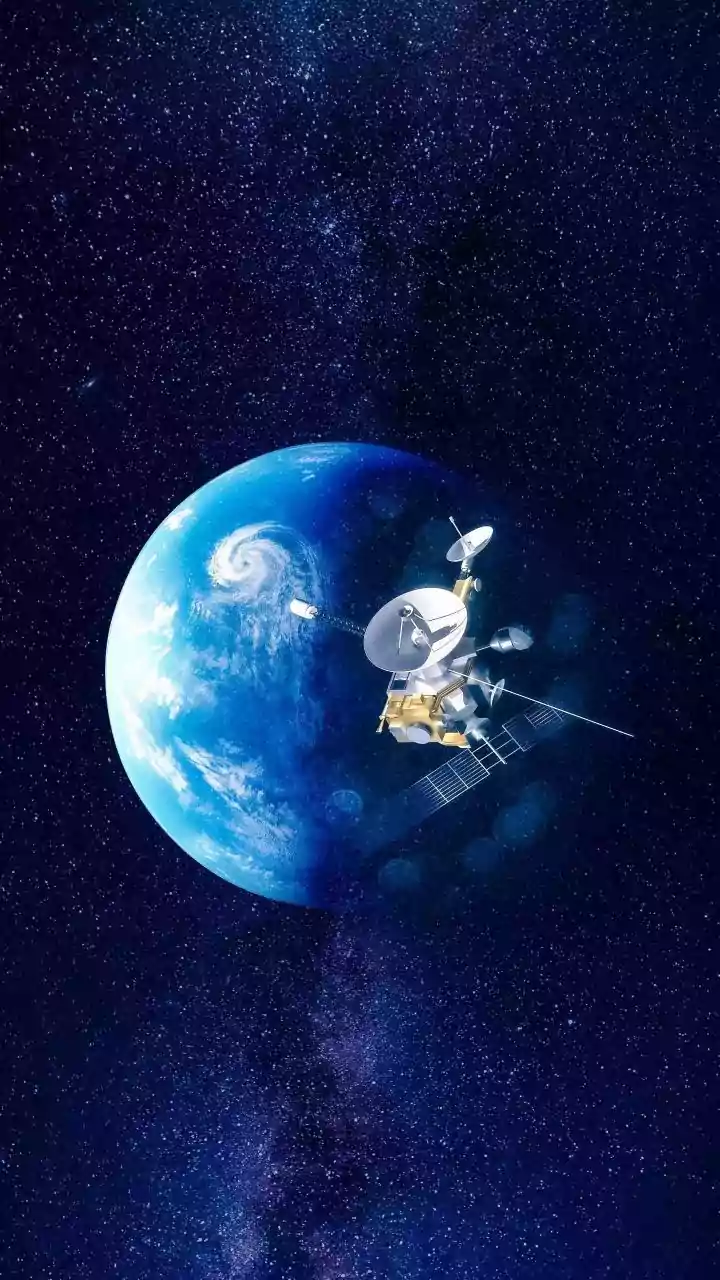
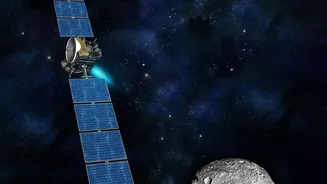
Launched nearly 50 years ago, NASA's Voyager 1 is a testament to human ambition. Now, as it sails through interstellar space, it's about to achieve something incredible: it will be one full light-day away from its creators on Earth.
A Journey Beyond Imagination
On September 5, 1977,
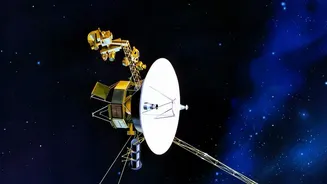
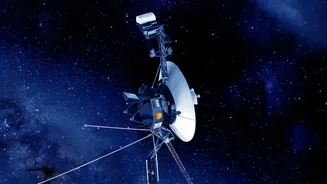
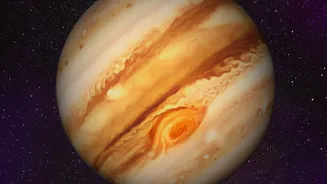
a Titan-Centaur rocket carried Voyager 1 into the Florida sky and toward the outer planets. Its original 'Grand Tour' mission was to study Jupiter and Saturn, and it performed spectacularly. In 1979, it revealed active volcanoes on Jupiter's moon Io and a faint ring around the gas giant itself. By 1980, it was sending back breathtaking images of Saturn's complex rings and discovering new moons. After its planetary flybys, its mission was extended. In 1998, it officially became the most distant human-made object in space, a title it has held ever since.
What is a Light-Day?
A light-day isn't a measure of time, but of immense distance. It is how far a beam of light, the fastest thing in the universe, travels in 24 hours. That equates to roughly 26 billion kilometres. To put that into perspective, light from the Sun takes a little over eight minutes to reach Earth. A radio signal sent to Voyager 1 on November 18, 2026, will take a full day to arrive. Any reply would take another day to get back, meaning a simple 'hello' and response would take 48 hours. For the probe to have traveled a distance that light crosses in a day has taken it more than 49 years.
Crossing into the Void
This isn't Voyager 1's first time making history in deep space. In August 2012, it achieved what was once science fiction: it crossed the heliopause. This is the boundary where the Sun's constant stream of particles, the solar wind, is no longer strong enough to push back the wind from other stars. By leaving this protective bubble, Voyager 1 became the first human-made object to enter interstellar space—the vast ocean between the stars. It is now sending back data from this uncharted territory, giving us our first direct measurements of the environment outside our solar system.
A Resilient Explorer
Keeping a nearly 50 year old spacecraft alive is a monumental challenge. Its plutonium power source decays over time, losing about four watts of power per year. To conserve energy, NASA engineers have been methodically shutting down instruments. Recently, in a delicate operation nicknamed the 'Big Bang', they swapped some components for lower power alternatives to extend its life. The probe has also given its team scares, including a recent 48 hour communication blackout in October 2026 that resolved itself when the probe automatically switched to a backup set of thrusters. These events highlight the ingenuity of the team managing this vintage hardware from billions of kilometres away.
The Golden Record's Silent Voyage
Bolted to the side of Voyager 1 is a message in a bottle for the cosmos: the Golden Record. This gold plated copper disk contains sounds and images selected to portray the diversity of life on Earth. Curated by a committee led by scientist Carl Sagan, it includes greetings in 55 languages, music from various cultures, and natural sounds like wind, surf, and whale songs. It also carries 116 images of human life, science, and the natural world. While the chance of it being found by an alien civilization is vanishingly small, the record serves as a beautiful and hopeful symbol of humanity's desire to connect.
What Lies Ahead for the Voyager?
Even as it celebrates this milestone, Voyager $^$ way is far from over, though its ability to communicate is finite. NASA anticipates that it will have to shut down the last of its science instruments in the $^$ays, and by $^$6$, its signal may be too faint for the Deep Space Network to detect. After it falls silent, the probe will continue its silent voyage through the Milky Way. Its next major cosmic landmark will be the Oort Cloud, a theoretical shell of icy bodies at the outermost edge of our solar system, which it will take about $^$00 years to reach. In about $^$000 years, it will pass relatively close to another star, Gliese $^$45.