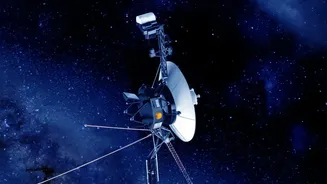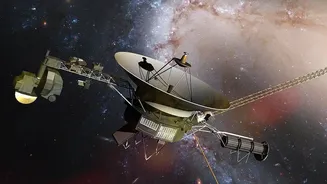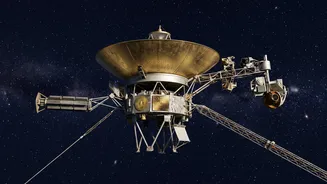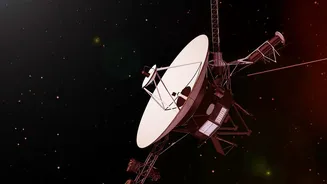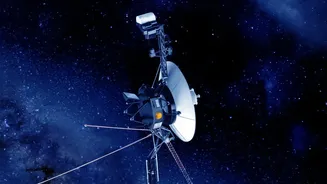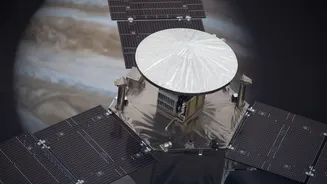



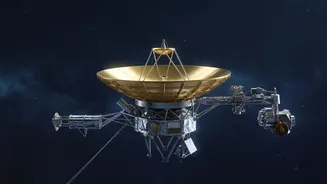
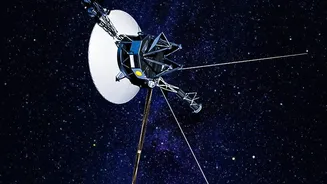
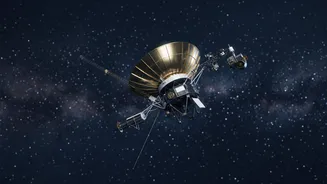
For two days, there was only silence. NASA's Voyager 1, humanity's farthest messenger, went quiet across billions of kilometres. The relief was immense when its signal returned, a testament to the resilience of 1970s technology.
A Sudden Silence Across the Void
On October 18 and 19, 2026,
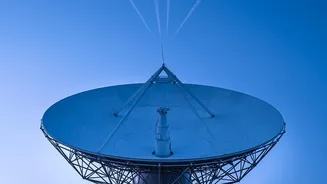
the giant antennas of NASA's Deep Space Network (DSN) listened for Voyager 1 and heard nothing. For a mission that has been operating for nearly 50 years, any unexpected silence is cause for major concern. The probe, currently travelling through interstellar space more than 25 billion kilometres away, is so distant that a round-trip message takes about 48 hours. This incredible distance means that when a problem occurs, engineers on Earth are working with a severe time lag, making every decision critical. The loss of contact came just weeks before Voyager 1 is set to achieve a historic milestone: on November 18, 2026, it will be one light-day from Earth, meaning its signal will take a full 24 hours to reach us.
An Automatic Fix, A Lingering Mystery
Then, on October 20, before the mission team could even send troubleshooting commands, Voyager 1's signal reappeared. The spacecraft had, remarkably, fixed itself. An initial investigation revealed that the probe’s onboard fault protection system had kicked in. It detected an issue with the primary set of thrusters, automatically switched to a backup set, and placed itself into a safe mode, pausing normal operations. This autonomous response, programmed decades ago, is what caused the communication pause and subsequent restoration. While engineers at NASA's Jet Propulsion Laboratory were relieved, they are still investigating the root cause of the initial thruster issue. Mission manager Kareem Badaruddin noted it was the first time they had seen the spacecraft perform this specific action, adding that at this late stage of the mission, they 'have to expect the unexpected'.
Keeping a Legend Alive
This recent scare is just the latest chapter in the long and delicate process of keeping the twin Voyager probes alive. Both spacecraft run on plutonium-powered generators that lose about four watts of power each year. To conserve energy, engineers have been systematically shutting down non-essential systems and even individual science instruments. Just weeks before the communication loss, the team performed a daring power-saving manoeuvre nicknamed the 'Big Bang', swapping three older, power-hungry devices for more efficient modern alternatives. These efforts are designed to extend the mission's life, hopefully allowing at least one science instrument to continue operating into the 2030s.
Humanity's Interstellar Emissary
Launched in 1977, Voyager 1's original mission was to study Jupiter and Saturn. It revolutionized our understanding of these gas giants, discovering Jupiter's faint rings, active volcanoes on its moon Io, and the complex nature of Saturn's rings. After completing its planetary tour in 1980, it began its long journey toward the stars. In 2012, it made history by becoming the first human-made object to enter interstellar space, the region beyond the protective bubble of solar wind created by our Sun. Today, its two remaining active instruments, a magnetometer and a plasma wave instrument, continue to send back unprecedented data about the space between stars. The probe also famously carries a 'Golden Record', a gold-plated copper disc containing sounds and images selected to portray the diversity of life and culture on Earth, a message in a bottle cast into the cosmic ocean.