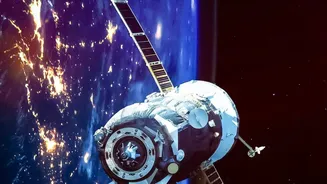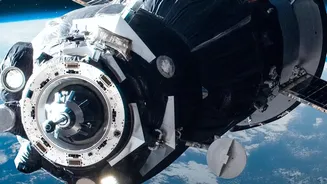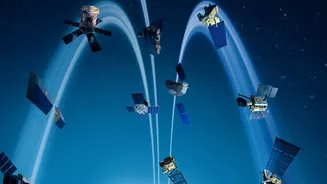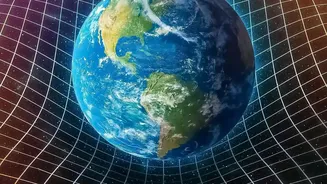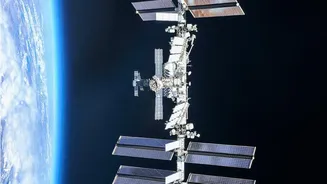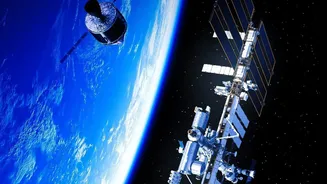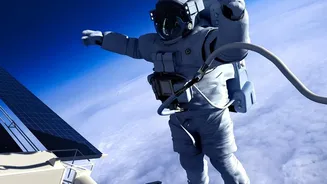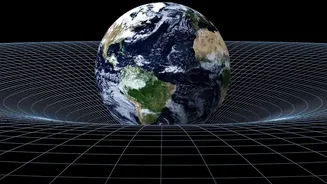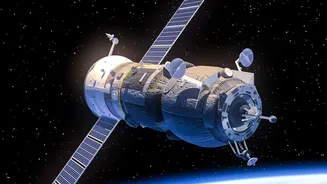




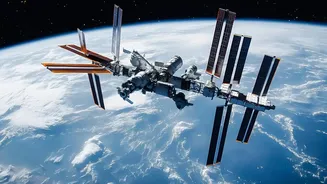
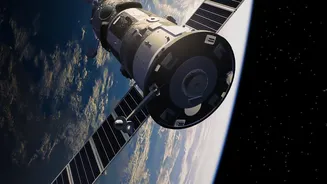
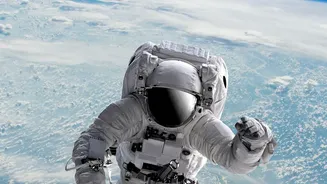
It sounds strange, but every satellite and even the International Space Station is constantly falling toward Earth. The only reason they don't crash is that they're also moving sideways at an incredible speed, a perfect cosmic balancing act.
Gravity Is Always On
First, let's
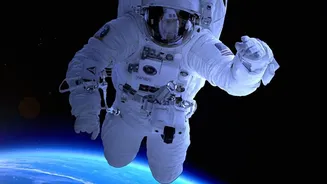
get one thing straight: there is plenty of gravity in orbit. At the altitude of the International Space Station (ISS), about 250 miles up, Earth's gravitational pull is still about 90% as strong as it is on the surface. Astronauts appear to float not because there's no gravity, but because they and their spacecraft are falling together at the same rate. It's the same feeling you’d get for a split second if an elevator cable snapped. Gravity is the essential force that makes an orbit possible; without it, any object in motion would simply fly off in a straight line into the void. So, if gravity is always pulling satellites down, how do they stay up?
The Secret Ingredient: Sideways Speed
The answer is horizontal velocity. Imagine throwing a baseball. It travels forward for a bit, but gravity pulls it downward, and it eventually hits the ground. Now, imagine you could throw that ball much, much faster. It would travel farther before it landed. If you could throw it at an astonishing speed—about 17,500 miles per hour (or 8 kilometers per second) in low Earth orbit—something magical happens. As the ball falls, the Earth's surface curves away beneath it. At just the right speed, the rate at which the ball falls toward the ground perfectly matches the rate at which the Earth curves away.
Falling Around The World
This is the essence of an orbit: it's a state of continuous freefall where an object's forward momentum is so great that it constantly 'misses' the planet it's falling toward. The craft is always being pulled down by gravity, but its immense sideways speed means its path bends around the planet instead of intersecting with the surface. This delicate balance between gravity (the downward pull) and inertia (the tendency to move in a straight line) is what we call orbital velocity. The result is that the satellite or spacecraft follows a circular or elliptical path, completing a full journey around the Earth without ever losing altitude, provided it maintains that specific speed.
Newton's Mountain-Top Cannon
The best way to visualize this comes from a 17th century thought experiment by Isaac Newton. He imagined a cannon placed on top of an impossibly tall mountain, high above any air resistance. If the cannon fires a ball at a low speed, it simply falls to the ground nearby. Fire it faster, and it travels further before landing. But if you fire the cannonball at exactly the right velocity, its path will curve downward at the same rate the Earth curves away. It will never land. Instead, it will circle the entire planet and return to the very mountain from which it was fired. That specific speed achieves a stable orbit.
A Cosmic Tightrope Walk
Achieving and maintaining an orbit is a precise science. If a satellite's velocity is too slow for its altitude, gravity will win the tug_of_war, and its orbit will decay until it re_enters the atmosphere and burns up. If its velocity is too high, it will begin to overpower gravity. A moderate increase might shift it into a higher, slower elliptical orbit. But if it reaches a speed known as 'escape velocity' (about 40% faster than orbital velocity), it will break free from Earth's gravitational pull entirely and fly off into space. The altitude also matters : the farther a satellite is from Earth, the weaker the gravitational pull and the slower the orbital velocity required to stay in its path. A satellite in a high geostationary orbit 22,223 miles up travels much slower than the ISS does in low Earth orbit.