


What Did Scientists See?
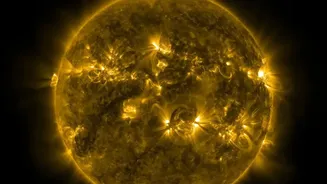
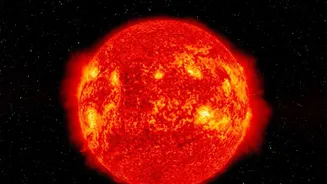
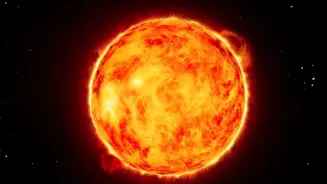
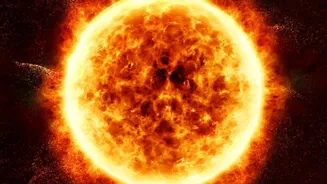
Using the remarkable capabilities of the Daniel K. Inouye Solar Telescope in Hawaii, astronomers have captured the highest-resolution images ever taken of the Sun's surface, known as the photosphere. Published recently, these observations revealed tiny,
swirling vortices of plasma at the edges of the familiar bubbling patterns, called granules, that cover the Sun. Some of these newly seen structures are incredibly small on a solar scale, just a few dozen kilometers wide. This groundbreaking observation allows scientists to see the Sun's magnetic field being twisted and moved by the hot gas in unprecedented detail.
A New Type of Wave
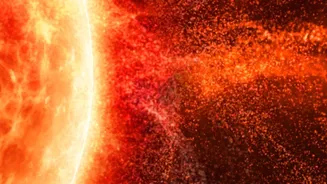
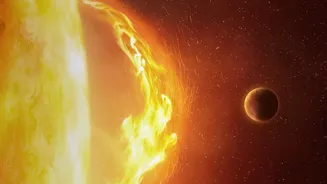
Researchers are interpreting these swirling motions as evidence of Kelvin-Helmholtz instabilities. This is a phenomenon in fluid dynamics that occurs when two fluids moving at different speeds meet, creating a shear that grows into wave-like vortices. You can see this effect in clouds or when wind blows over water. On the Sun, it appears that adjacent layers of plasma are flowing past each other at different speeds, creating these newly observed patterns. This is different from the more well-known solar tsunamis, or EUV waves, which are massive, large-scale disturbances often triggered by huge explosions like coronal mass ejections (CMEs). Those 'tsunamis' travel across the Sun at immense speeds, up to 1000 kilometers per second. The newly seen waves are a much smaller, more intricate phenomenon, offering clues to physics on a different scale.
Unlocking Solar Secrets
This discovery is more than just a pretty picture; it provides a new window into some of the Sun's biggest mysteries. For decades, scientists have puzzled over the 'coronal heating problem'—why the Sun's outer atmosphere, the corona, is millions of degrees hotter than its surface. The twisting motions observed in these tiny vortices are thought to build up magnetic energy, which can then be released. This process could help explain how energy is transported and released into the corona, contributing to its extreme temperatures. Essentially, these small-scale events could be a key part of the larger energy budget of the Sun, helping to explain processes like nanoflares, which are small but constant bursts of energy.
The Tools That Made It Possible
Observing such fine details on a star 149 million kilometers away is a monumental technological achievement. The discovery was made possible by the National Science Foundation's Daniel K. Inouye Solar Telescope, the world's largest and most powerful solar telescope. Its advanced optics can resolve features on the Sun's surface with incredible clarity. These observations were then combined with sophisticated computer simulations to interpret what was being seen. This combination of cutting-edge observation and powerful modeling is crucial for advancing our understanding of solar physics. Missions like the Solar Orbiter and Parker Solar Probe are also providing invaluable data from up close, working in concert to measure plasma, magnetic fields, and the solar wind.
Why This Matters for Us on Earth
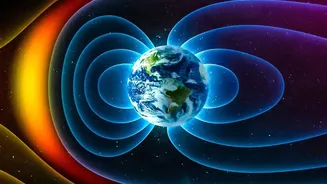
While the Sun's physics may seem remote, its behavior has a direct impact on our technologically dependent world. The Sun constantly releases a stream of charged particles called the solar wind. Explosive events like solar flares and CMEs can supercharge this wind, sending storms of energy towards Earth. This 'space weather' can pose a significant threat. It can damage critical satellites, disrupt GPS navigation, and even bring down power grids. By better understanding the fundamental physics of how the Sun stores and releases energy—even at these newly observed small scales—scientists can improve their models for predicting space weather. This gives us a better chance to protect our vital infrastructure from the Sun's powerful outbursts.