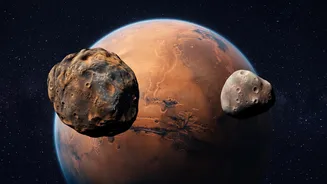


When we picture a moon, we think of a majestic, glowing sphere, much like our own. But Mars's two moons, Phobos and Deimos, defy this image. They are small, dark, lumpy, and shaped more like potatoes than planetary companions.
Mars's Lumpy Companions
Discovered in 1877 by American
astronomer Asaph Hall, Phobos and Deimos are named after the Greek gods of fear and dread, who accompanied their father Ares (the Greek equivalent of Mars) into battle. Both are among the smallest moons in the solar system. Phobos, the larger of the two, is about 22 kilometres across, while Deimos is a mere 12 kilometres wide. They orbit very close to Mars; Phobos is so close it circles the planet three times a day, while Deimos takes about 30 hours. Unlike our Moon, they are not bright and reflective. Instead, they are dark, heavily cratered, and covered in dust, appearing more like asteroids than traditional moons.
Why Aren't They Round?
The simple reason for their irregular shape is a lack of size and mass. For a celestial body to become spherical, it must have enough gravity to pull all its material inward, overcoming its own structural rigidity. This process is called achieving hydrostatic equilibrium. Phobos and Deimos are far too small for this to happen. Their gravitational pull is so weak that their lumpy, rocky composition holds its shape, leaving them as potato-like objects tumbling through space. A person weighing 68 kilograms on Earth would weigh only about 68 grams on Phobos. It takes a much larger body, typically several hundred kilometres in diameter, to generate the gravity needed to become a sphere.
Theory One: Captured Asteroids
For decades, the leading theory was that Phobos and Deimos were asteroids that strayed too close to Mars and were captured by its gravity. This hypothesis seems plausible given their appearance; their composition is very similar to carbon-rich C-type asteroids commonly found in the asteroid belt between Mars and Jupiter. They are dark, have low density, and are heavily cratered, all hallmarks of such asteroids. However, this theory has a major problem: their orbits. Captured objects typically have eccentric, tilted orbits. Phobos and Deimos, on the other hand, have nearly perfect circular orbits that lie almost exactly on Mars's equatorial plane. It's very difficult for orbital models to explain how captured asteroids could have settled into such stable, circular paths.
Theory Two: A Giant Impact
A more recent and increasingly favoured hypothesis suggests the moons were born from Mars itself. Much like how Earth's Moon is believed to have formed from debris after a massive collision, this theory posits that a giant object—perhaps a protoplanet—smashed into early Mars. This cataclysmic event would have blasted a massive ring of rock and debris into orbit around the planet. Over time, this material would have clumped together, or accreted, to form Phobos and Deimos. This 'giant impact' scenario neatly explains their tidy, equatorial orbits, which would be a natural result of forming from a debris disk. However, this theory also has its challenges. Spectroscopic analysis suggests the moons' composition is different from Mars's crust, which is not what you'd expect if they were made from Martian material.
Awaiting a Verdict from MMX
The debate over the origin of Phobos and Deimos remains one of the great unsolved mysteries of the inner solar system. Fortunately, answers may be on the horizon. The Japan Aerospace Exploration Agency (JAXA) recently launched the Martian Moons eXploration (MMX) mission in October 2026. This ambitious spacecraft will travel to the Martian system, arriving in 2027, to study both moons in detail. The mission's primary goal is to land on Phobos, collect at least 10 grams of surface material, and return it to Earth for analysis in 2031. By studying an actual sample, scientists hope to finally determine the moons' composition and definitively solve the puzzle of their origin. The mission will also deploy a small rover to explore the surface of Phobos and will conduct flyby observations of Deimos.