



What Is This Celestial Alignment?
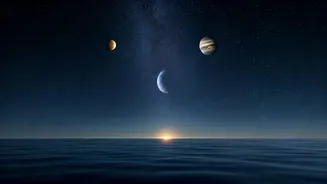
The event is known as a conjunction. In simple terms, a conjunction occurs when two or more celestial objects appear to be very close to each other in the sky from our perspective on Earth. In reality, the Moon and Venus are millions of kilometres apart,
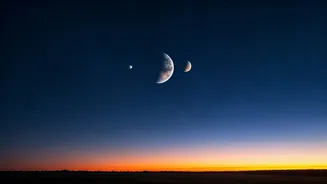
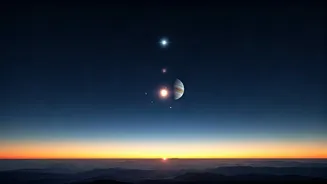
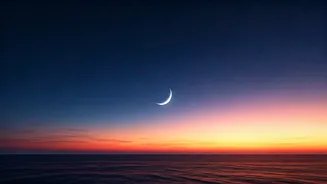
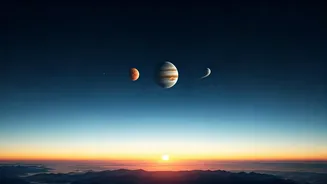
but their orbits are bringing them into the same line of sight for us. Tomorrow's alignment is particularly special because it involves the two most brilliant objects in our night sky after the Sun. Venus, often called the 'Evening Star' when it appears after sunset, will shine with a steady, intense light. It will be joined by a slender, waxing crescent Moon, adding a delicate and beautiful arc of light to the scene. This pairing in the colourful twilight sky is what makes it a prime target for sky-gazers and astrophotographers.
When and Where to Look in India
The best time to view this spectacle is shortly after sunset. Start looking about 30 to 45 minutes after the sun has dipped below the horizon. This is the 'blue hour' of twilight, when the sky is a deep, rich blue, but not yet completely dark. The colours provide a stunning backdrop for the bright pairing. You don’t need a specific location, just a clear view of the western sky. An unobstructed horizon, free from tall buildings or trees, will give you the best and longest viewing window. Venus will be unmistakably bright, and the crescent Moon will be right near it. The pair will be visible for about 60 to 90 minutes before they follow the Sun and set below the western horizon. This is an event you can enjoy from your balcony, terrace, or a nearby park.
Do You Need a Telescope?
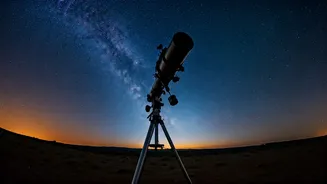
Absolutely not! This is one of the most accessible astronomical events, perfectly visible to the naked eye. The brightness of both the Moon and Venus makes them easy to spot, even from light-polluted urban areas. However, if you have a pair of binoculars, you will be rewarded with an even better view. Binoculars will resolve the crescent shape of the Moon more clearly and might even reveal 'earthshine' – the faint glow on the dark part of the Moon caused by sunlight reflecting off the Earth. Through binoculars, Venus will appear as a sharp, brilliant point of light. A telescope is not necessary, but if you have one, you might be able to see the phases of Venus, which looks like a tiny version of our own Moon.
Tips for Smartphone Photography
You don't need a fancy camera to capture this moment. Your smartphone is more than capable if you use a few tricks. First, find a way to keep your phone steady. Prop it against a wall or use a small tripod. Any shaking will result in a blurry photo. Open your camera app and switch to 'Night Mode' or 'Pro/Manual Mode' if you have it. Tap the screen on the Moon or Venus to set the focus. Then, find the exposure setting (often a sun icon) and slide it down. This is crucial because both objects are very bright, and the auto mode will likely overexpose them, turning them into white blobs. Lowering the exposure will reveal the crescent shape of the Moon and keep Venus as a distinct point. Be patient and take several shots.
Advice for Dedicated Photographers
For those with a DSLR or mirrorless camera, this is a chance to capture a classic astrophoto. A tripod is non-negotiable for sharpness. Use a lens somewhere in the 50mm to 200mm range to frame the conjunction along with some of the twilight colours or a foreground silhouette. Switch to manual mode (M). Start with a low ISO (100-400) to minimise noise, an aperture between f/4 and f/8 for sharpness, and a shutter speed between 1/2 a second and 2 seconds. Use your camera’s live view screen to zoom in and manually focus on Venus for a perfectly sharp shot. Using a 2-second timer or a remote shutter will prevent camera shake when you press the button. Experiment with your settings as the sky darkens to get the perfect balance between the bright celestial objects and the ambient light.