



The Challenge of Capturing the Cosmos
Photographing stars has always been difficult. Our eyes are magnificent, but phone camera sensors are tiny. Distant stars and galaxies are incredibly faint, and capturing their light requires the camera's shutter to stay open for a long time. The problem
is, a single long exposure on a phone usually results in a blurry, noisy mess. Any tiny movement, including the rotation of the Earth, can cause stars to appear as streaks instead of sharp points. Furthermore, small sensors generate a lot of digital 'noise'—a graininess that can obscure the faint starlight you're trying to capture.
The Software That Outsmarts Hardware
This is where computational photography steps in. It's a collection of clever software techniques that help smartphone cameras overcome their physical limitations. Instead of relying solely on a big lens and sensor like a traditional DSLR camera, your phone uses its powerful processor to intelligently capture and combine image data. When you switch to a 'Night Mode' or a dedicated 'Astro Mode', your phone isn't just taking one picture; it's executing a complex software-driven process designed to pull a clear image out of near-darkness.
Unpacking the Magic of Exposure Stacking
The core technique behind modern smartphone astrophotography is called exposure stacking. Instead of attempting one risky, minutes-long exposure, the phone captures a series of many shorter shots, often over several minutes. For example, instead of one four-minute photo, it might take sixteen separate 15-second photos. This approach has two major benefits. First, the shorter exposures prevent stars from trailing due to the Earth's rotation. Second, it allows the software to tackle the problem of digital noise.
How Stacking Creates Clarity
Think of digital noise as random speckles appearing in a different pattern on each photo. The light from a star, however, is the 'signal', and it stays in a consistent position relative to other stars in each frame. When the phone's software aligns all the images by the stars, it can then average the pixel data. The random noise, which is different in every shot, gets averaged out and fades away. The consistent starlight, or signal, gets reinforced and becomes brighter and clearer. This process of increasing the signal-to-noise ratio is what allows faint objects to emerge from the darkness.
An Automated Observatory in Your Pocket
Modern astrophotography modes automate this entire process. When placed on a tripod, the phone detects its stability and begins the sequence. It captures dozens of frames, with some phones using artificial intelligence to separate the sky from the foreground, aligning the stars in the sky portion of the images while keeping the landscape sharp. The software then intelligently merges these aligned frames to create a final, composite image that is significantly brighter and more detailed than any single frame could be. Advanced algorithms also handle colour correction and enhance details in celestial objects like the Milky Way.
What's Possible and What Are the Limits?
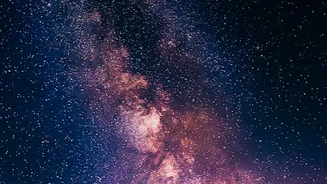
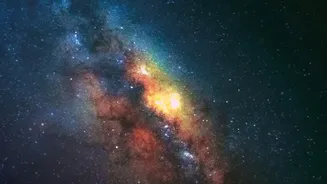
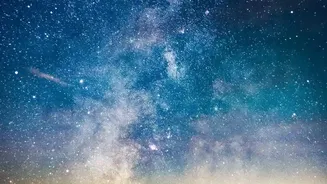
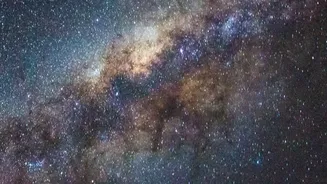
The results can be astonishing, revealing constellations, the glow of the Milky Way, and even nebulae that are completely invisible to the naked eye. However, the technology has its limits. It works best in dark locations away from city light pollution, and a tripod is almost always necessary for the phone to remain perfectly still. While a smartphone won't replace a dedicated telescope and professional camera setup, it has made a once-niche and expensive hobby accessible to hundreds of millions of people. This democratization of astrophotography is arguably the technology's greatest achievement.