



Understanding the Movement
The standing torso twist is a dynamic stretch that involves rotating your upper body from side to side while your lower body remains stable. More than just a warm-up, this exercise is a lesson in proprioception—your body's ability to sense its own position
and movement in space. By focusing on the rotation originating from your core and spine, you train your brain to become more aware of your posture and alignment. This heightened awareness is crucial for correcting the unconscious slouching and stiffness that can build up from prolonged sitting. The goal isn't to twist as far as possible, but to move with control and intention, feeling how each segment of your spine contributes to the rotation.
The Core Benefits of Twisting
Incorporating standing torso twists into your routine offers a range of benefits beyond a simple stretch. It primarily targets your oblique muscles, which are essential for rotational strength and a stable core. A strong, flexible spine is fundamental to overall health, and this exercise directly promotes spinal mobility and can help alleviate lower back stiffness caused by inactivity. The twisting motion also gently massages the abdominal organs, which can aid in digestion. For athletes, improved rotational power is key for sports like cricket, tennis, and golf. For everyone else, it translates to easier, pain-free daily movements, from carrying groceries to turning to look behind you.
Your Step-by-Step Guide
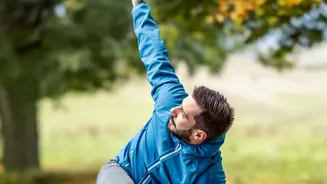
Proper form is crucial to maximise benefits and prevent injury. Follow these steps for a safe and effective standing torso twist. 1. Starting Position: Stand with your feet shoulder-width apart and your knees slightly bent. This creates a stable base. Keep your posture tall, with your chest up and shoulders relaxed. 2. Arm Placement: Bend your arms at a 90-degree angle at your sides, or cross them over your chest. Alternatively, you can extend them straight out in front of you. 3. Engage Your Core: Before you move, gently tighten your abdominal muscles. Imagine bracing yourself as if someone is about to lightly poke your stomach. This protects your lower back. 4. The Twist: Exhale and slowly rotate your torso, shoulders, and head to one side. The movement should come from your waist, not from swinging your arms. Allow the opposite foot to pivot slightly, with the heel lifting off the floor, to enable a smooth rotation through the hips and prevent stress on your knees. 5. Return and Repeat: Inhale as you return to the centre with control. Then, exhale as you twist to the other side. The entire movement should be fluid and deliberate, not rushed.
Common Mistakes to Avoid
To get the most out of this exercise, be mindful of these common errors: Using Momentum: One of the biggest mistakes is swinging your arms and using momentum to 'throw' your body into the twist. This not only reduces the effectiveness for your core muscles but can also strain your lower back. Focus on slow, controlled movement. Moving Only the Arms: Ensure the rotation originates from your mid-spine and waist. Your arms and shoulders should follow your torso, not lead the movement. Keeping Feet Planted: Forcing a deep twist while keeping your feet rigidly planted can put unnecessary torque on your knees. Allowing your back foot to pivot is a safer and more natural way to move. Arching or Rounding the Back: Maintain a long, neutral spine throughout the exercise. Avoid hunching your shoulders or excessively arching your lower back.
Ways to Modify the Twist
You can easily adjust the standing torso twist to suit your fitness level and needs. For Beginners: If you are new to the movement or have balance concerns, perform the twist while seated in a chair. This provides stability and allows you to focus purely on the spinal rotation. To Add a Challenge: Hold a light weight, such as a dumbbell or a medicine ball, close to your chest. This adds resistance and further engages your core muscles. * For Greater Mobility: Incorporate the twist into a lunge. Step back into a lunge position and then rotate your torso over your front leg. This variation challenges your balance and increases mobility in your hips.