






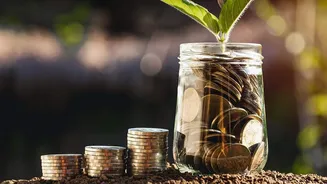
What is The Compounding Effect?
At its core, compounding is simple: it’s the process of earning returns on your returns. When you invest, your money earns interest. The next year, you earn interest not just on your original investment, but also on the interest from the first year. Think
of it like a snowball rolling downhill. It starts small, but as it rolls, it picks up more snow, getting bigger and bigger at an ever-increasing rate. In financial terms, every rupee of earnings becomes a new worker, generating its own earnings alongside your initial capital. This creates an exponential growth curve, where the gains are modest at first but become dramatically larger in the later years of the investment.
Time is Your Most Valuable Asset
When it comes to compounding, the single most important ingredient is time. The amount you invest is secondary to the amount of time you let it grow. Let’s consider an example with two friends, Anjali and Ben. Anjali starts investing ₹5,000 per month in a Systematic Investment Plan (SIP) at age 25. Ben thinks he has plenty of time and starts investing the exact same amount, ₹5,000 per month, at age 35. Both invest until they are 60 and we'll assume they get a conservative 12% annual return, which is around the historical long-term average for Indian equity markets. By age 60, Anjali, who invested for 35 years, would have a corpus of approximately ₹3.24 crore. Ben, who invested for 25 years, would have a corpus of just ₹95 lakh. Anjali invested for only 10 more years, but her final wealth is more than three times greater than Ben's. That staggering difference is purely the result of giving her money an extra decade to compound.
The Alarming Cost of Delay
Looking at the Anjali and Ben example another way reveals the true cost of procrastination. The 10-year delay cost Ben over ₹2 crore in potential wealth. For Ben to catch up to Anjali’s final corpus by age 60, he would need to invest not ₹5,000, but over ₹17,000 per month starting from age 35. He would have to invest more than three times the monthly amount just to make up for one lost decade. This illustrates a crucial point: the money you invest in your 20s is by far the most powerful money you will ever save. Every year you wait doesn't just mean you've saved less; it means you've forfeited the enormous growth that those early investments would have generated over the subsequent decades. The opportunity cost of waiting is immense.
How to Get Started Today
The belief that you need a large sum of money to start investing is a common myth. Thanks to instruments like Systematic Investment Plans (SIPs), you can begin with as little as ₹500 per month. SIPs allow you to invest a fixed amount regularly into mutual funds, which is a simple and disciplined way to build wealth. For a young earner, starting is more important than starting big. The key is to build the habit of investing consistently. As your income grows, you can gradually increase your SIP amount. With less financial responsibility early in your career, you have a greater ability to let your money work for you over a long horizon, smoothing out market fluctuations and maximizing the power of compounding.