



The Great Martian Challenge
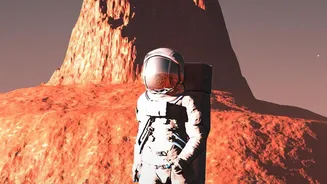
Landing humans on Mars is one thing; keeping them alive is another. The Red Planet’s atmosphere is fundamentally hostile to human life. It’s more than 100 times thinner than Earth’s and is composed of about 95% carbon dioxide, with only trace amounts
of oxygen. Breathing it is impossible. Furthermore, the extreme cold and low pressure would be instantly fatal without a sophisticated spacesuit. Historically, any long-term mission to Mars would have required astronauts to bring massive, heavy tanks of oxygen with them—not just for breathing, but also as a critical component of the rocket propellant needed for the return journey to Earth. This immense weight makes such a mission prohibitively expensive and complex. The solution? Learn to live off the land.
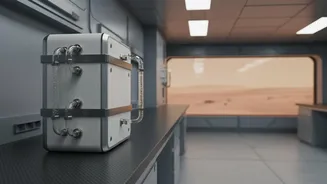
A Golden Box of Life
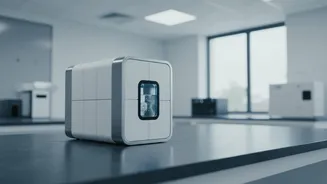
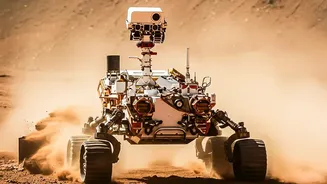
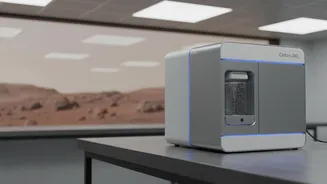
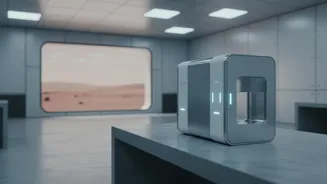
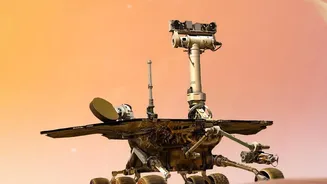
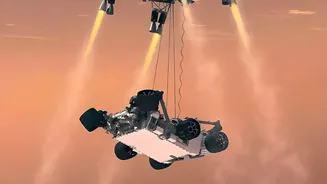
Enter the Mars Oxygen In-Situ Resource Utilization Experiment, or MOXIE. This small, car-battery-sized instrument, nestled in the belly of NASA's Perseverance rover, is a revolutionary piece of technology. Its mission is straightforward but audacious: to prove it's possible to reliably produce oxygen by harvesting the abundant carbon dioxide in the Martian atmosphere. Developed by a team at the Massachusetts Institute of Technology (MIT), MOXIE is the first-ever demonstration of using a planet's local resources to create something essential for human missions. It’s a test run for a future where astronauts can generate their own breathable air and rocket fuel millions of kilometres from home.
Cooking Up Oxygen at 800°C
So how does this lunchbox-sized chemical plant work? The process is a form of high-temperature electrolysis. First, MOXIE acts like a vacuum, sucking in Martian air through a filter to clean it of dust. Then, it compresses and heats this CO2-rich air to a scorching 800 degrees Celsius. This superheated gas is fed into an instrument called a Solid Oxide Electrolyzer (SOXE), which uses an electrochemical process to split the carbon dioxide molecules (CO2). Each molecule of carbon dioxide is made of one carbon atom and two oxygen atoms. The intense heat and electricity effectively break these bonds. The process separates the oxygen atoms, which then combine to form breathable, molecular oxygen (O2). The waste product, carbon monoxide (CO), is harmlessly vented back into the Martian atmosphere along with other gases.
A Breath of Martian Air
MOXIE has proven to be a resounding success. Since the Perseverance rover landed in 2021, the instrument has completed multiple operational runs under a variety of Martian conditions—day and night, and across different seasons. In its first test, it produced about 5 grams of oxygen, enough for an astronaut to breathe for roughly 10 minutes. Across its entire mission, MOXIE generated a total of 122 grams of oxygen. At peak efficiency, it produced 12 grams per hour, achieving this at a purity of 98% or better, which is twice what NASA initially hoped for. While this may sound modest—roughly what a small dog breathes in 10 hours—it's a monumental proof of concept. It shows that the core technology is sound and can operate reliably in the harsh Martian environment.
Blueprint for a Red Planet Colony
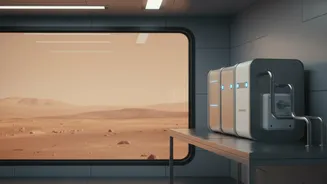
MOXIE is just a first step, a small-scale demonstrator. To support a human mission, scientists envision a much larger system, perhaps the size of a small freezer, capable of producing oxygen continuously. Such a scaled-up device could generate oxygen at a rate equivalent to several hundred trees, producing kilograms of oxygen per hour. The primary goal for this industrial-scale production wouldn't just be for life support, but for creating the massive quantities of liquid oxygen needed for rocket propellant. To lift a crew of four astronauts off the Martian surface for their return trip, an estimated 25 tons of oxygen would be required. By manufacturing this on-site over a couple of years before astronauts even arrive, a mission could shed the immense weight of carrying it from Earth. This capability is critical to making sustained human exploration of Mars a feasible reality.