



A Day Longer Than a Year
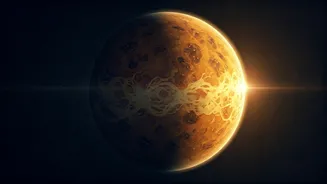
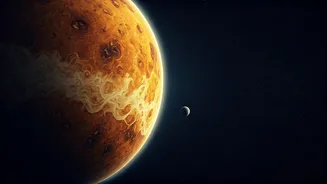
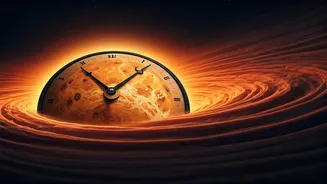
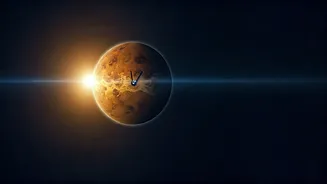
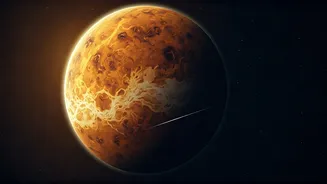
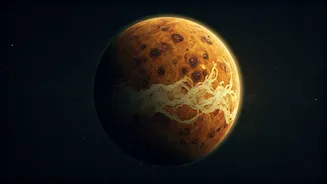
Let’s wrap our heads around that for a moment. Venus takes about 225 Earth days to complete one orbit around the Sun—that’s its year. However, it takes a staggering 243 Earth days to spin just once on its axis. This means if you were standing on Venus,
you would experience a full year before you experienced a full day-night cycle. This profound sluggishness makes Venus the slowest-rotating planet in our solar system by a huge margin. For comparison, Earth spins once in 24 hours, and even the gas giant Jupiter, over 300 times more massive than Earth, completes a rotation in under 10 hours. Venus moves at a crawl, a celestial snail in a race of spinning tops.
Spinning the Wrong Way
As if being incredibly slow wasn’t strange enough, Venus also spins backwards. All planets in our solar system orbit the Sun in the same direction, and most also rotate on their axis in that same direction (prograde). But Venus spins in the opposite direction, known as retrograde rotation. If you could see through its thick clouds, you would watch the Sun rise in the west and set in the east. Only one other major planet, Uranus—which is tipped over on its side—shares this sort of rotational oddity. This backward spin is a major clue that something dramatic happened in Venus’s distant past to set it apart from its planetary siblings.
The Thick Atmosphere's Heavy Hand
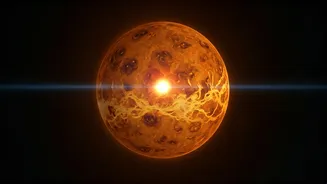
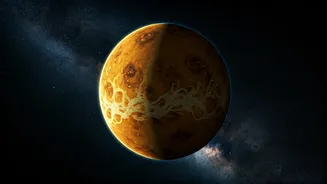
So, what caused this cosmic slowdown? One of the leading theories points to Venus's most infamous feature: its crushingly dense atmosphere. The Venusian atmosphere is over 90 times thicker than Earth’s and is composed mostly of carbon dioxide, creating a runaway greenhouse effect with surface temperatures hot enough to melt lead. This thick, soupy atmosphere is in constant motion, creating powerful winds that circle the planet in just four Earth days—a phenomenon known as super-rotation. Scientists believe this atmosphere creates a strong “atmospheric tide.” This isn't a tide of water, but a gravitational pull exerted by the Sun on the dense atmosphere, which then drags on the solid planet beneath it. Over billions of years, this constant friction has acted like a powerful brake, slowing Venus’s spin to its current leisurely pace.
Echoes of a Violent Past?
Another compelling theory suggests a more cataclysmic origin for Venus’s strange spin. In the chaotic early days of the solar system, collisions between large celestial bodies were common. It is possible that Venus was struck by a massive planet-sized object long ago. Such an impact could have been powerful enough to not only halt its original, faster prograde rotation but actually reverse it. Some models suggest a series of smaller impacts over time could have had a similar effect. While the atmospheric tide theory explains the current slowdown, a colossal ancient impact might be the reason it started spinning backward in the first place. These two theories aren't necessarily mutually exclusive; a long-ago impact could have set the stage for the atmospheric braking that we see today.
Why This Puzzle Matters
For scientists, Venus’s rotation isn't just a quirky piece of trivia; it’s a crucial piece of the puzzle in understanding how planets form and evolve. By studying why Venus turned into a toxic hothouse while Earth became a haven for life, we learn more about the delicate balance that makes a planet habitable. The relationship between a planet's rotation, its atmosphere, and its climate is fundamental. Understanding the extreme case of Venus helps us refine our models for planets both in our solar system and those orbiting other stars (exoplanets). Every mission that peers through Venus's clouds gives us more data to unravel the mystery of its axial sluggishness, offering a window into the dynamic and sometimes violent history of our cosmic neighbourhood.